


The Speed Debate in Canajoharie: What Your AC’s Compressor Actually Does
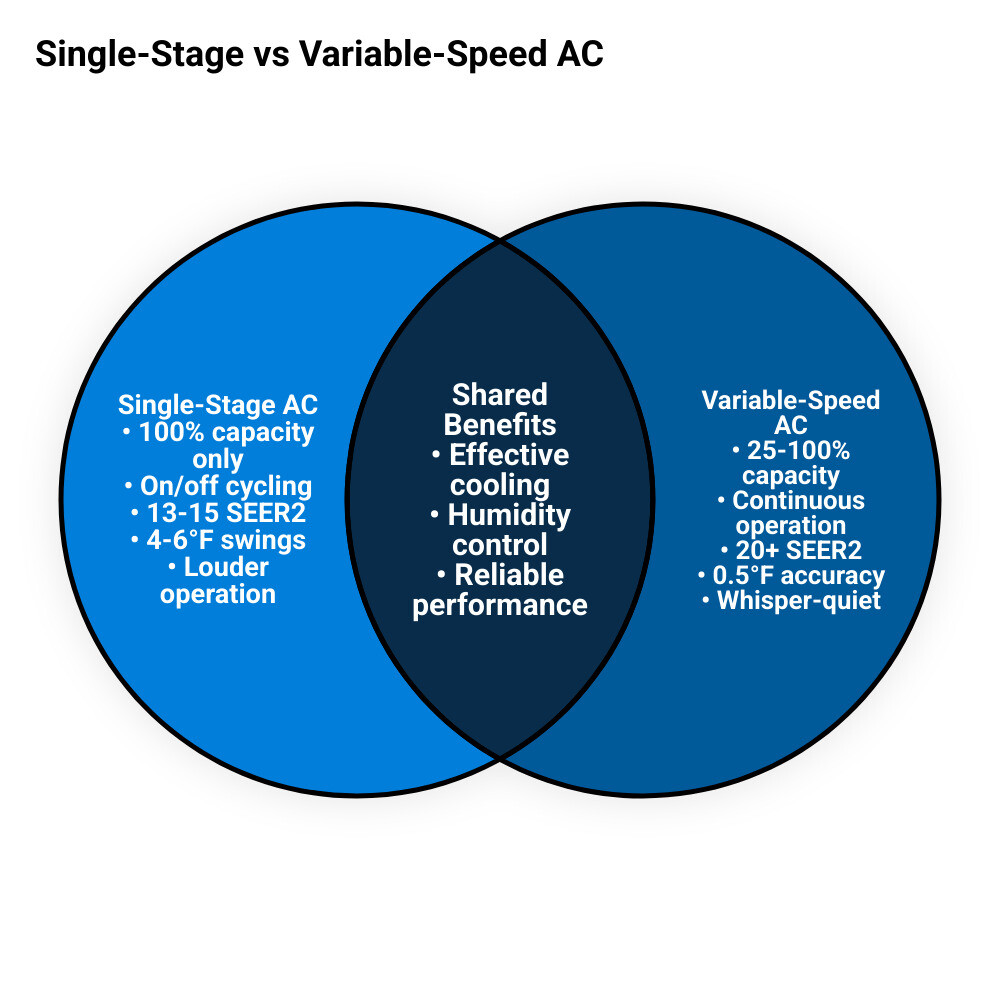
Single stage vs variable speed AC explained simply: a single-stage unit runs at full blast every time it turns on, then shuts off completely. A variable-speed unit adjusts its output continuously — anywhere from 25% to 100% capacity — to match exactly how much cooling your home needs at any given moment.
Here’s a quick side-by-side to help you decide:
| Feature | Single-Stage | Variable-Speed |
|---|---|---|
| How it runs | 100% on or completely off | 25%-100%, adjusts continuously |
| Temperature accuracy | +/- 4-6°F swings | Within 0.5°F of setpoint |
| SEER2 efficiency rating | 13-15 | 20+ (up to 23.6) |
| Humidity removal | Basic | Superior (longer run cycles) |
| Noise level | Louder (full-power starts) | Whisper-quiet |
| Upfront cost | Lower | Higher |
| Long-term energy savings | Lower | Up to 55% less than single-stage |
For most Canajoharie homeowners, the choice comes down to this: single-stage is simpler and cheaper upfront, while variable-speed delivers better comfort, lower energy bills, and superior humidity control over time.
If you’ve ever walked into a room in your home and found it stuffy and warm while another room felt like a freezer, your AC’s compressor is likely the culprit. Summers in Montgomery County may not feel as brutal as Florida or Texas, but the humidity here is real — and the way your air conditioner handles that humidity depends almost entirely on how its compressor operates.
About 70-80% of homes still run single-stage systems. They work, but they cycle on and off frequently, which creates uneven temperatures, adds wear to the equipment, and leaves more moisture in the air. Variable-speed systems take a different approach entirely — running longer, slower cycles that quietly and steadily keep your home comfortable.
Understanding the difference can save you money, improve your comfort, and help you make a smarter decision the next time your system needs replacing.
What is a Single-Stage Air Conditioner?
A single-stage air conditioner is the most traditional type of cooling system on the market. If your home in Montgomery County is older than 10 years, there is a very high probability that you are currently using one. The technology is straightforward: the compressor has one speed—100% capacity. It is either completely on or completely off.
Think of it like a light switch. When your thermostat detects that the indoor temperature has risen above your setpoint, it signals the AC to kick on. The unit immediately ramps up to full power to blast cold air into your home. Once the target temperature is reached, it shuts off entirely.
While this “all or nothing” approach has been the industry standard for decades and currently occupies 70-80% of the market share, it comes with some inherent drawbacks. Because it only operates at full throttle, it often overshoots the cooling goal, leading to temperature swings of 4-6°F. This creates that familiar cycle of feeling a bit too chilly while the air is blowing, only to feel stuffy again ten minutes after the unit shuts down.
However, many homeowners still choose this path when looking for AC service in Canajoharie, NY because of its reliability and lower initial investment. It is a “tried and true” technology that is easier for most technicians to service and features parts that are widely available.
Single Stage vs Variable Speed AC Explained: The Technology Shift
The real “game changer” in modern HVAC technology is the variable-speed compressor, often referred to as inverter technology. To understand single stage vs variable speed ac explained in terms of daily operation, imagine the difference between a car that only has “neutral” and “floored” versus a car with a modern gas pedal that lets you cruise at 30 mph, 55 mph, or 70 mph depending on the road.
A variable-speed system can operate anywhere from 25% to 100% capacity. It rarely needs to run at full power unless it is a record-breaking scorcher in the Mohawk Valley. Instead, it “hums” along at a lower speed for longer periods. This continuous operation allows the system to maintain a precise temperature within 0.5°F of your thermostat setting.
When you invest in AC installation service in Canajoharie, NY, choosing variable speed means moving away from frequent on/off cycles. This is crucial because the “startup” phase of an air conditioner is when it uses the most electricity and experiences the most mechanical stress. By staying on at a low, efficient hum, a variable-speed unit actually experiences less wear and tear over time than a single-stage unit that starts and stops dozens of times a day.
Comparing Efficiency, Comfort, and Humidity Control
When we compare these two technologies, the differences become clear across three main categories: efficiency, comfort, and air quality.
| Performance Metric | Single-Stage | Variable-Speed |
|---|---|---|
| SEER2 Rating | 13 – 15 | 20+ (Up to 23.6) |
| Energy Savings | Standard | Up to 55% Savings |
| Humidity Control | Moderate | Superior |
| Sound Level | 72-76 decibels | 55-60 decibels |
| Temp. Stability | +/- 4-6°F | +/- 0.5°F |
How is a single stage vs variable speed AC explained in terms of SEER2?
SEER2 (Seasonal Energy Efficiency Ratio 2) is the yardstick used to measure how much cooling a system provides per watt of electricity used. As of April 2026, efficiency standards have become more stringent.
Single-stage systems typically hover between 13 and 15 SEER2. While these units meet basic requirements, they are significantly less efficient than variable-speed models, which frequently exceed 20 SEER2. Because a variable-speed unit can throttle down to a low-power mode, it can provide up to 55% energy savings on your monthly utility bills compared to a standard single-stage unit. Over the 15-to-20-year lifespan of a system, those savings can easily eclipse the initial price difference.
Is a single stage vs variable speed AC explained as better for humidity?
In places like Broadalbin or Sharon Springs, summer humidity can make 80 degrees feel like 90. Your air conditioner’s secondary job is to act as a dehumidifier. However, an AC only removes moisture while it is actually running.
Because a single-stage unit cools the house very quickly and then shuts off (a process called “short-cycling”), it often doesn’t run long enough to pull significant moisture out of the air. This leaves you with “cold and clammy” air.
Conversely, a variable-speed unit runs longer cycles at a lower speed. This consistent airflow allows the evaporator coil to pull much more moisture out of the air, significantly improving indoor air quality and preventing mold growth. If you frequently find yourself needing AC repair service in Canajoharie, NY due to frozen coils or drainage issues, it may be because your single-stage unit is struggling with the local humidity loads.
Maintenance and Longevity for Modern Systems
Regardless of which system you choose, longevity is tied directly to how well the unit is maintained. Most modern AC systems are designed to last between 12 and 20 years.
Variable-speed systems are often built with higher-grade components to handle the inverter technology. While they have fewer “hard starts” (which saves the compressor from electrical spikes), they do contain more complex electronics and proprietary control boards. This makes it vital to sign up for an HVAC maintenance plan in Canajoharie, NY.
During a precision tune-up, we check:
- Electrical connections: Ensuring the inverter is communicating properly with the thermostat.
- Refrigerant levels: Variable systems are very sensitive to precise refrigerant charges.
- Ductwork integrity: Variable-speed blowers need proper static pressure to operate efficiently.
- Cleaning: Keeping the coils clean is essential for those long, low-speed run cycles to be effective.
One unique advantage of variable speed is that because it avoids the “thump” of a full-power startup, the mechanical components often stay in better alignment for longer. However, if a specialized part does fail, it can sometimes take longer to source than a generic single-stage capacitor or relay.
Frequently Asked Questions about AC Stages
Choosing a new system involves navigating a lot of terminology. Here are some of the most common questions we hear from our neighbors in Montgomery and Schoharie counties. For more detailed answers, you can always visit our HVAC system FAQ.
Is variable speed worth it for smaller homes in Montgomery County?
It depends on your priorities. If you live in a small, well-insulated ranch in Palatine, a single-stage unit might be perfectly sufficient because the cooling load is low. However, if your home has multiple levels or large windows, a single-stage unit will likely struggle with “hot spots.” Variable speed is often “worth it” for the comfort alone, as it eliminates the upstairs/downstairs temperature divide by keeping air moving constantly.
How much quieter is a variable speed unit compared to single-stage?
The difference is noticeable. A single-stage unit starts with a loud “clunk” and a roar of the fan. Variable-speed units use “soft-start” technology, ramping up so gradually you might not even realize they are on. At their lowest speeds, they are about as loud as a quiet conversation or a refrigerator hum (around 55 decibels), whereas a single-stage unit can sound like a vacuum cleaner running outside your window (75+ decibels).
Do variable speed units require special thermostats?
Yes. To get the full benefit of a variable-capacity compressor, you usually need a “communicating” thermostat. Unlike a standard thermostat that just says “on” or “off,” a communicating thermostat talks to the AC in real-time, sharing data about humidity levels and outdoor temperatures so the system can adjust its speed in tiny increments—sometimes as many as 700 different levels.
Conclusion
Deciding between a single-stage and a variable-speed air conditioner is a choice between upfront simplicity and long-term luxury and efficiency. If you are looking for a straightforward, budget-friendly replacement for a home you might not stay in forever, a single-stage unit is a solid, reliable workhorse. But if you want the ultimate in home comfort, whisper-quiet operation, and the lowest possible utility bills, variable speed is the clear winner for our New York climate.
At Don’s Electric & Plumbing Inc., we’ve been family-owned and operated since 1984. We understand the specific needs of homeowners in Canajoharie, Cobleskill, Broadalbin, and throughout the surrounding counties. Whether you need a quick repair or a full system upgrade, we back our work with a 100% satisfaction guarantee and offer 24/7 emergency service for those unexpected summer breakdowns.
Ready to see which system is the perfect fit for your home? Schedule an estimate with our team today, and let’s get your home back to the perfect temperature.