


The Real Consequences of Electrical Work Without a Permit in New York
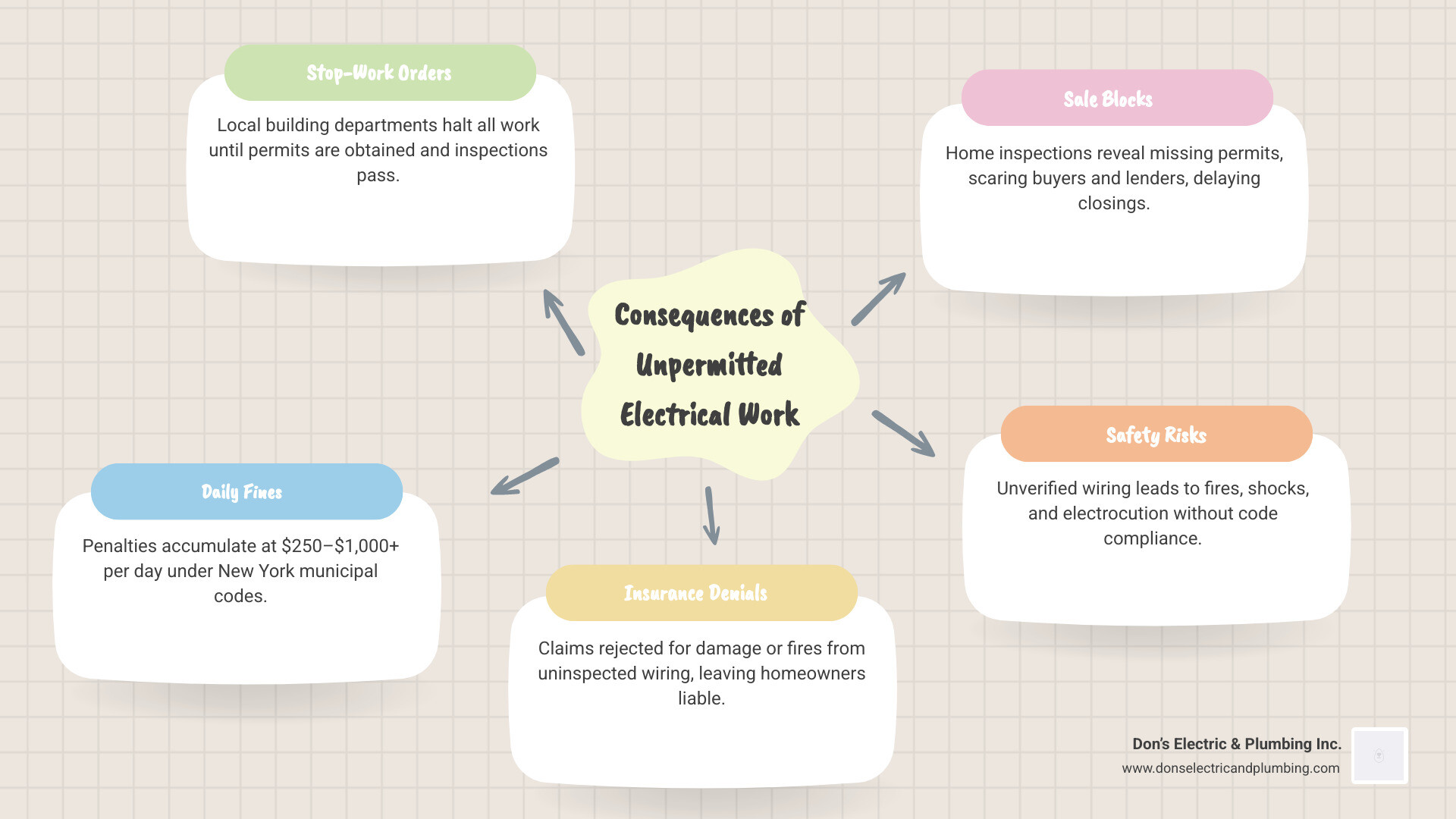
The consequences of electrical work without a permit can be serious — and they don’t go away once the drywall goes up. Here’s a quick overview of what you could be facing:
- Stop-work orders issued by your local building department
- Daily fines that can reach hundreds or even thousands of dollars
- Insurance claim denials if unpermitted wiring causes a fire or damage
- Blocked home sales due to permit violations discovered during inspections
- Forced demolition or wall exposure to allow retroactive inspections
- Personal liability if someone is injured due to non-compliant wiring
- Inherited violations that transfer to new owners at closing
Many homeowners in Canajoharie and across Montgomery County assume that as long as the work looks good and nothing goes wrong, skipping a permit is no big deal. But unpermitted electrical work has a way of surfacing at the worst possible moments — during a home sale, after a fire, or when a utility upgrade triggers an inspection.
Licensed electricians and local building departments in New York take permitting seriously because electricity is unforgiving. Work that isn’t inspected has no independent verification that it’s safe — and the consequences can extend far beyond a fine.
What are the immediate legal and financial consequences of electrical work without a permit?

When we talk about the immediate consequences of electrical work without a permit, we usually start with the “knock on the door.” In many of the areas we serve, like Palatine, Minden, and Sharon Springs, municipal code enforcement officers are responsible for ensuring that all structural and electrical modifications meet New York State Uniform Fire Prevention and Building Codes.
If a neighbor reports loud construction or an inspector notices a new service entrance while driving by, the first thing they will do is issue a stop-work order. This is a legal mandate that halts all activity on your property immediately. You cannot resume work until the proper permits are pulled, and in many cases, you’ll have to pay a “triple permit fee” as a penalty for starting without authorization.
The financial sting doesn’t stop at permit fees. Depending on the local ordinances in your specific town — whether you’re in Little Falls or Gloversville — daily fines can begin to accrue. In some New York municipalities, these fines can reach up to $500 or even $1,000 per day until the violation is cured. If the case goes to court, a judge can impose even steeper penalties.
Furthermore, unpermitted work is often discovered when you try to do things the right way later. For example, if you decide to install a standby generator in Broadalbin, the inspector who comes to sign off on the generator might notice that the subpanel you installed two years ago was never permitted. This triggers retroactive penalties and may require you to hire a licensed professional to verify the previous work. For more help with your home’s power, you can find More info about electrical services.
Will my home insurance cover damage from unpermitted electrical modifications?
This is perhaps the most devastating financial risk a homeowner can take. Your homeowner’s insurance policy is a contract. One of the conditions of that contract is that you maintain a safe environment and comply with local laws. When you perform electrical work without a permit, you may be committing what insurance companies call “material misrepresentation” or an “increase in hazard.”
If a fire starts in a wall where unpermitted wiring was installed, your insurance provider has a very strong legal ground to deny your claim entirely. They may argue that because the work was never inspected by a municipal official or a third-party agency, the risk of the home was higher than what they agreed to insure. In the worst-case scenarios, an insurer might even void your entire policy, leaving you with a total loss and no way to rebuild.
[TABLE] Insurance Outcomes: Permitted vs. Unpermitted Electrical Work
| Feature | Permitted & Inspected Work | Unpermitted Electrical Work |
|---|---|---|
| Claim Eligibility | Full coverage for accidental fire/damage | High risk of claim denial |
| Liability Protection | Covers injuries to guests/workers | May leave homeowner personally liable |
| Policy Status | Remains in good standing | Potential for policy cancellation |
| Resale Value | Protects and increases home value | Can lead to significant price drops |
| Safety Assurance | Verified by independent inspector | No guarantee of code compliance |
Beyond fire damage, there is the issue of personal liability. If a guest in your home in Middleburgh or Cobleskill is injured by an electrical shock or a fire caused by unpermitted work, your liability coverage may not protect you. You could be sued personally for medical bills and damages, facing a life-altering financial burden. To ensure your home is up to standard, check out More info about electrical installation.
Safety hazards and code violations in New York homes
Building codes, specifically the National Electrical Code (NEC) which New York adopts with state-specific amendments, are not just “red tape.” They are the result of decades of research into how to prevent houses from burning down and people from getting electrocuted.
The consequences of electrical work without a permit often manifest as hidden safety hazards. When work isn’t inspected, common mistakes go unnoticed:
- Improper Grounding: This is one of the most common DIY or “handyman” errors. Without a proper ground path, a fault in an appliance or fixture can turn the entire device into a live wire, waiting to shock the next person who touches it.
- Overloaded Circuits: Adding new outlets or lights to an existing circuit without calculating the load can lead to overheating. While a circuit breaker should trip, unpermitted work often involves oversized breakers on undersized wires, which is a recipe for a house fire.
- Faulty Connections: Loose wires in a junction box create resistance, which generates heat. Over time, this heat can char the surrounding wood or insulation, eventually leading to an arc fault and fire.
- Arc Faults: Modern codes require AFCI (Arc Fault Circuit Interrupter) protection in most living areas. Unpermitted work often skips these more expensive breakers, leaving the home vulnerable to the types of spark-based fires that regular breakers can’t detect.
For homeowners in rural areas like Wells or Hope, where fire department response times might be longer than in a city, these safety risks are even more critical. Ensuring your home has proper, permitted lighting and power is essential for peace of mind. You can find More info about lighting services.
Safety Hazards: The Dangerous Consequences of Electrical Work Without a Permit
One of the most terrifying events an electrician can witness is an arc flash. This occurs when electricity leaves its intended path and travels through the air, creating a blast of heat and light that can reach temperatures hotter than the surface of the sun. This usually happens because of non-compliant wiring or poor panel maintenance.
When we perform a professional installation or repair, we ensure that every connection is torqued correctly and that surge protection is in place to handle unexpected spikes from the grid. Without a permit and a subsequent inspection, there is no one to double-check that these life-saving measures were taken. Protect your sensitive electronics and your family by getting More info about surge protection.
I’m trying to sell my house in Canajoharie. Will missing permits block the sale?
In April 2026, the real estate market remains as competitive as ever, and buyers are more savvy about permit history than they used to be. If you’re trying to sell a home in Montgomery or Schoharie County, unpermitted work is a massive “red flag” that can derail a closing at the last minute.
During the due diligence period, a buyer’s home inspector will look for signs of “new” work. They might see fresh Romex wiring in an old basement or a modern electrical panel in a 1920s house. Their first question will be: “Was this permitted?” If you cannot provide the paperwork, the buyer may get cold feet, or their mortgage lender might refuse to fund the loan.
Lenders for FHA and VA loans are particularly strict. They often require a “Certificate of Occupancy” or “Certificate of Approval” for any significant modifications. If there is an open permit violation or evidence of unpermitted structural/electrical changes, they will likely reject the property until the issue is cleared. This usually results in the seller having to pay for emergency repairs and retroactive inspections just to keep the sale alive. If you’re planning an upgrade to prepare for a sale, start with More info about panel upgrades.
Real Estate Delays: The Consequences of Electrical Work Without a Permit During a Sale
When unpermitted work is found during a title search or a point-of-sale inspection, the “fix” is rarely cheap or fast. You may be forced into “remediation,” which means hiring a licensed electrician to come in, inspect the work, and often tear it out and redo it to meet current 2026 codes.
Buyers will also use missing permits as a powerful negotiating tool. They might demand a price reduction that far exceeds the actual cost of the permit, simply because of the perceived risk and the “hassle factor” they are inheriting. In New York, disclosure laws are quite clear: if you know about unpermitted work, you are legally required to disclose it. Failing to do so can lead to a lawsuit from the buyer long after the keys have changed hands. To avoid these headaches, consider More info about rewiring services.
How to fix past mistakes with retroactive permits
If you’ve realized that your home in Herkimer or Fulton County has unpermitted work — perhaps from a previous owner or a DIY project gone wrong — don’t panic. There is a path to compliance, though it requires patience and professional help.
The process usually involves applying for a retroactive permit (sometimes called an “as-built” permit). Here is how we typically help homeowners navigate this:
- Initial Assessment: We perform a thorough inspection of the unpermitted work to see if it meets current NEC standards.
- Exposing the Work: This is the part most homeowners dread. To verify that the wiring inside the walls is correct (proper stapling, junction box usage, and wire gauge), the municipal inspector will often require us to remove sections of drywall.
- Remediation: If we find code violations — which is common in unpermitted work — we must fix them. This might involve replacing undersized wires or adding required GFCI/AFCI protection.
- Third-Party Certification: In many parts of our service area, like Sharon Springs or Ephratah, the town may require an independent electrical inspection agency to certify the work before the building department will close the permit.
- Final Approval: Once the work is verified to be safe and code-compliant, the town issues a Certificate of Approval, effectively “legalizing” the work and clearing your property title.
While this process can be more expensive than doing it right the first time, it is the only way to protect your home’s value and your family’s safety. If you’re worried about work that’s already been done, get More info about electrical repairs.
Frequently Asked Questions about Electrical Permits
What happens if I do electrical work without a permit in New York?
You face a combination of legal, financial, and safety risks. This includes stop-work orders, daily fines from your local building department, and the potential denial of insurance claims. Furthermore, unpermitted work can prevent you from selling your home or securing a mortgage, and it poses a significant fire hazard if not done to code.
Can I get a permit for electrical work already done?
Yes, this is known as a retroactive or “as-built” permit. You will likely have to pay a penalty fee to your local municipality. You will also need a licensed electrician to inspect the work, which often requires opening up walls so the inspector can see the wiring and connections. Any parts of the work that don’t meet current codes will have to be redone.
Does replacing a light fixture require a permit?
In most New York jurisdictions, like Canajoharie or Little Falls, “like-for-like” replacements — such as swapping an old light fixture for a new one or replacing a broken outlet — do not require a permit. However, if you are running a new wire, adding a new circuit to your panel, or moving the location of a fixture, a permit is almost always required.
Conclusion
The consequences of electrical work without a permit are simply not worth the short-term savings. Whether it’s the threat of a denied insurance claim, the stress of a stalled home sale, or the literal danger of an electrical fire, the risks far outweigh the cost of doing things by the book.
At Don’s Electric & Plumbing Inc., we’ve been serving our neighbors in Montgomery, Fulton, Schoharie, Herkimer, and Hamilton counties since 1984. As a family-owned and operated business, we care about the safety of our community. We understand the local codes in Sharon Springs, Broadalbin, and Little Falls, and we handle the permitting process so you don’t have to worry about it.
We stand behind our work with a 100% satisfaction guarantee and offer financing options to help make your necessary home upgrades manageable. Don’t let unpermitted work haunt your home’s future. Schedule your professional electrical inspection today and let us ensure your home is safe, compliant, and ready for whatever the future holds.