


Why the New York Building Code for Home Electrical Work Matters in 2026
New york building code for home electrical work has changed significantly, and if you own a home in New York, you need to know what rules apply to you right now.
Here is a quick summary of what the current code requires:
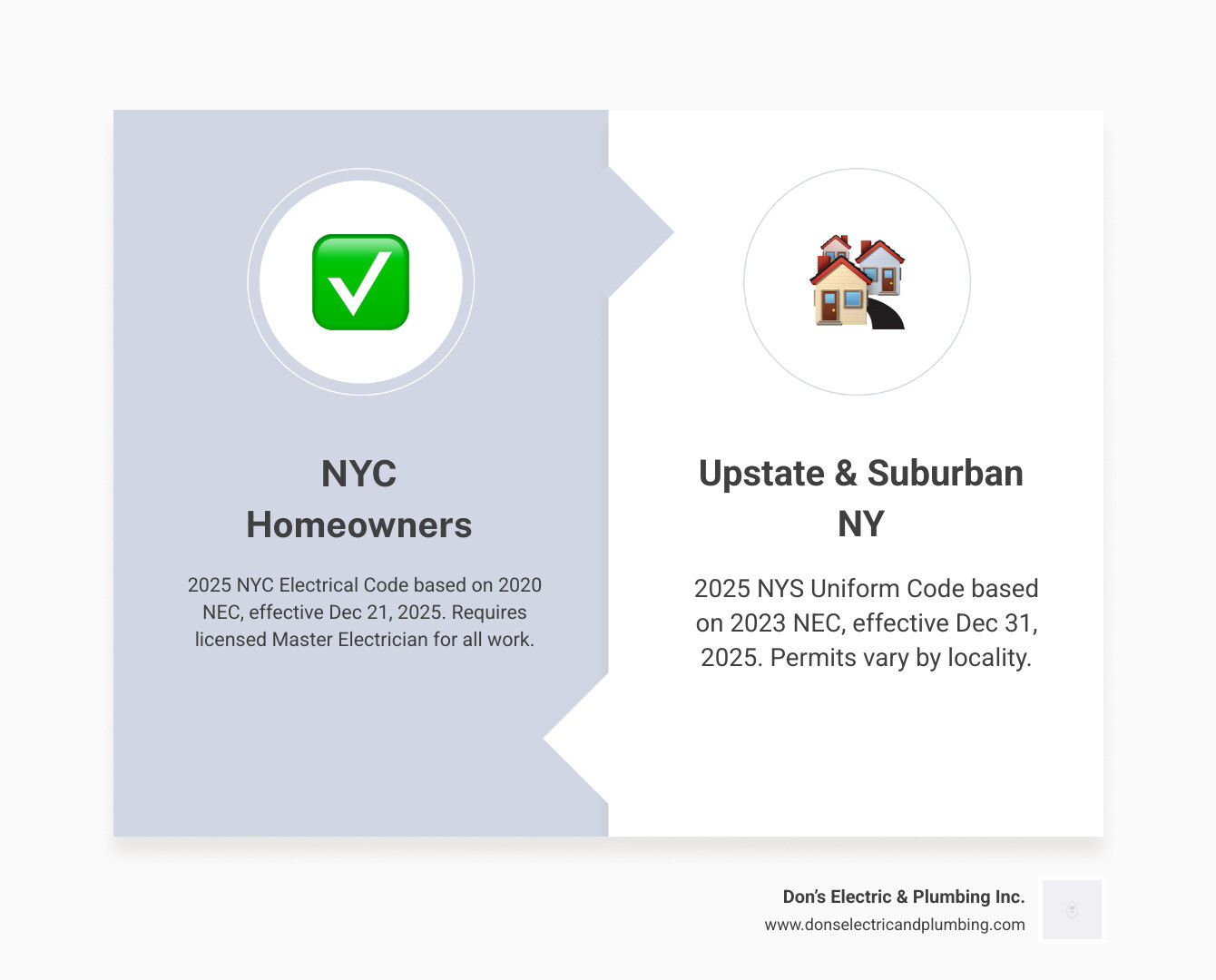
- NYC homeowners fall under the 2025 New York City Electrical Code, based on the 2020 NFPA 70 (NEC), which took full effect December 21, 2025
- Upstate and suburban NY homeowners fall under the 2025 New York State Uniform Code, which references the 2023 NEC, effective December 31, 2025
- Permits are required for new circuits, panel replacements, service upgrades, and most wiring changes
- Like-for-like replacements (such as swapping a broken outlet for an identical one) are generally exempt from permits
- All electrical work in NYC must be performed by a licensed Master Electrician — no exceptions
- AFCI and GFCI protection is now required in more areas of the home than ever before
- Voltage drop must not exceed 5% total from the service point to the farthest outlet
- Electrical equipment must be installed above the design flood elevation in flood hazard areas
Non-compliant wiring is one of the leading causes of residential fires in the United States, according to the U.S. Fire Administration. That is not a statistic worth gambling with.
Whether you are planning a kitchen remodel, adding a new circuit, or just trying to understand what your electrician is telling you, this guide walks you through every key requirement clearly and simply.
Understanding the 2025 New York Building Code for Home Electrical Work
Navigating the new york building code for home electrical work can feel like trying to untangle a giant ball of Christmas lights. In New York, we deal with a “layered” regulatory system. Depending on where your house is—whether you’re in the heart of the city or enjoying the quiet life in Montgomery or Fulton County—the rules change.
As of May 2026, we are operating under two primary frameworks. In New York City, the 2025 NYC Electrical Code is the law of the land. It is based on the 2020 edition of the National Electrical Code (NEC) but includes a heavy dose of “NYC Amendments.” These amendments often make the code stricter than the national standard to account for the unique density of the city.
For those of us in the rest of the state, including our neighbors in Canajoharie and Gloversville, we follow the 2025 New York State Uniform Code. This code officially adopted the 2023 National Electrical Code (NEC) as its baseline on December 31, 2025. This was a big jump from the previous 2017 NEC standards we used for years. The 2023 NEC brings in advanced safety requirements for things like outdoor emergency disconnects and expanded GFCI protection.
Why the update? The New York State Code Council, a 19-member body appointed by the Governor, periodically reviews these standards to ensure our homes are equipped to handle modern electrical loads—think electric vehicle (EV) chargers, heat pumps, and high-end smart home systems. If you’re living in an older home, understanding Common Home Electrical Hazards and How to Avoid Them is the first step in deciding if your system needs a code-mandated upgrade.

When Do You Need a Permit for Residential Projects?
A common question we hear is, “Do I really need a permit just to add one outlet?” The answer is usually yes. In New York, the line between “minor repair” and “alteration” is very clear.
If you are doing a “like-for-like” replacement—meaning you’re swapping a old, cracked outlet for a brand-new one in the same spot—you generally don’t need a permit. However, the moment you run a new wire, move a panel, or add a circuit, the local Authority Having Jurisdiction (AHJ) wants to see a permit.
| Project Type | Permit Required? | NYC Rule | Upstate/Suburban Rule |
|---|---|---|---|
| Swapping a light fixture | No | Exempt | Exempt |
| Replacing a broken outlet | No | Exempt | Exempt |
| Adding a new 20-amp circuit | Yes | Must use Master Electrician | Permit required from AHJ |
| Upgrading from 100A to 200A | Yes | Must use Master Electrician | Permit & Utility Coordination |
| Installing an EV Charger | Yes | Must use Master Electrician | Permit & Load Calc Required |
| Fixing a loose wire in a box | No | Exempt (Repair) | Exempt (Repair) |
In New York City, the rules are even tighter. All electrical work must be performed by a licensed Master Electrician, and unlicensed work is strictly prohibited. Upstate, while some areas allow homeowners to perform certain tasks, the liability and safety risks are high. Unlicensed work can actually void your homeowner’s insurance if a fire occurs. This is one of the Common Electrical Issues: Why You Legally Can’t Fix Everything yourself.
Key Technical Standards for Modern Home Safety
The new york building code for home electrical work isn’t just about red tape; it’s about physics and fire prevention. One of the most important technical standards is Voltage Drop. The code states that the maximum total voltage drop from the service point to the farthest outlet should not exceed 5%. If the drop is higher, your appliances have to work harder, get hotter, and wear out faster.
Then we have the “Safety Trifecta”: AFCI, GFCI, and Grounding.
- AFCI (Arc-Fault Circuit-Interrupter): These are designed to detect “arcing”—small sparks caused by frayed wires or loose connections. Under the 2023 NEC (and the 2025 NYC Code), AFCI protection is required in almost all “living” areas, including bedrooms, dining rooms, and hallways.
- GFCI (Ground-Fault Circuit-Interrupter): These protect you from shocks in wet areas. You need these within 6 feet of any sink, in bathrooms, garages, outdoors, and in crawl spaces.
- NM Cable (Romex): In most of New York State, nonmetallic-sheathed cable (NM) is perfectly fine for homes. However, if you are in NYC or working on a multifamily building over three stories, NM cable is often restricted in favor of metal-clad (MC) cable or conduit for better fire protection.
For a full breakdown of what to look for in your own house, check out The Ultimate Home Electrical Safety Checklist for Beginners.
Specific New York Building Code for Home Electrical Work in Kitchens and Bedrooms
Kitchens are the most electrically demanding rooms in the house. The code requires at least two 20-amp “small appliance branch circuits” for countertop outlets. These cannot power lights—they are strictly for your coffee makers, toasters, and blenders.
Additionally, if you are installing a room air conditioner, the code has specific receptacle requirements. You cannot simply plug a high-powered AC unit into a shared circuit with your TV and computer. It usually requires a dedicated branch circuit to prevent overloads.
In bedrooms, the 2023 NEC has expanded the use of tamper-resistant outlets. These have little shutters inside that prevent a child from sticking a paperclip into the slot. It’s a small detail that saves lives.
Safety Requirements for Service Equipment and Utility Meters
The way power enters your home is also strictly regulated. For a one-family residence, only one utility meter is permitted. If you’re converting a basement into a legal apartment, you’ll need to update the Certificate of Occupancy and potentially the service entrance to allow for a second meter.
Main disconnects must be easily accessible. The code requires a “working space” in front of electrical equipment that is at least 30 inches wide and 6.5 feet high. You cannot use your electrical room as a broom closet or storage unit—it must be dedicated solely to electrical equipment.
For larger installations (1000 kVA or greater), New York requires a formal Electrical Plan Review and a service room with a 2-hour fire rating. While most homes won’t hit that 1000 kVA threshold, large estates or multi-family buildings in our area certainly can.
Specialized Rules: Flood Zones and Emergency Power
If you live near the water in Schoharie or Montgomery County, you need to be aware of ASCE 24 standards. In flood hazard areas, the new york building code for home electrical work requires that all electrical utilities, including meters and panels, be located at or above the “design flood elevation.” Water and electricity don’t mix, and keeping your panel dry during a storm is a life-safety priority.
We also see a lot of interest in emergency and standby power systems. Whether it’s a portable generator or a stationary unit (like a Generac), there are rules to follow:
- Stationary Generators: Must be listed under UL 2200.
- Transfer Switches: You must use a listed transfer switch to prevent “backfeeding” power into the utility lines, which can be fatal for line workers.
- Response Time: While residential systems vary, true “Emergency Power” systems must kick in within 10 seconds of a power failure.
For these high-stakes installations, it’s best to leave the heavy lifting to the pros. See our guide on why you should Don’t Be a Hero and Call an Electrician for These Jobs.
Inspections, Licensing, and Maintenance Responsibilities
Once the work is done, the job isn’t over. You need an inspection. In New York, this usually happens in two stages:
- Rough-in Inspection: This happens while the walls are open. The inspector checks the wire gauge, box depth, and routing.
- Final Inspection: This happens once the devices are installed and the power is on.
In many parts of our service area, such as Fulton County, you might need an Electrical Inspection in Gloversville to close out your permit and ensure your home is safe for your family.
Navigating the New York Building Code for Home Electrical Work Inspections
Scheduling an inspection can be a headache if you don’t know the local process. In NYC, you use the “DOB NOW” system. In Upstate NY, it often involves a third-party inspection agency like the New York Board of Fire Underwriters or a similar authorized agency.
As a homeowner, you are legally responsible for the maintenance of your electrical system. The Property Maintenance Code of New York State requires that all electrical equipment be maintained in a safe and functional condition. If you notice flickering lights or warm switch plates, you should call a Licensed Safety Electrician in Palatine immediately.
Frequently Asked Questions about NY Electrical Codes
Can a homeowner perform their own electrical work in New York?
This depends entirely on your local “Authority Having Jurisdiction” (AHJ). In New York City, the answer is a hard no—all work must be done by a licensed Master Electrician. In many Upstate counties, homeowners are allowed to do some work on their own primary residence, but they are still required to pull permits and pass the same rigorous inspections as a professional. Given the complexity of the 2023 NEC, most homeowners find that the risk of a failed inspection or a fire isn’t worth the savings. We always recommend an Electrical Safety Inspection in Gloversville if you’re unsure about work previously done on your home.
What is the maximum voltage drop allowed by the New York code?
The code recommends a maximum total voltage drop of 5%. This is split between the feeder (the wires from your main panel to a sub-panel) and the branch circuits (the wires from the panel to your outlets). Keeping voltage drop low ensures your appliances run efficiently and prevents wires from overheating.
When did the 2023 NEC become effective in New York State?
The 2023 National Electrical Code became the mandatory standard for all of New York State (excluding NYC) on December 31, 2025. Any project with a building permit issued on or after that date must comply with the 2023 NEC. Projects with permits issued before that date may still follow the 2017 NEC during a brief transition period, but it’s always safer to build to the newest standards.
Conclusion
Keeping up with the new york building code for home electrical work is a full-time job—literally! Since 1984, our family at Don’s Electric & Plumbing Inc. has been helping our neighbors stay safe, warm, and powered up. Whether you’re in Montgomery, Fulton, or Schoharie County, we know the local inspectors, the local utility rules, and exactly what the 2025 updates mean for your home.
We offer a 100% satisfaction guarantee, emergency services for those midnight power failures, and financing options to help you get your home up to code without the stress. From the historic homes of Sharon Springs to new builds in Broadalbin, we’re here to ensure your electrical system is a source of comfort, not a hazard.
Ready to make sure your home is code-compliant? Schedule your code-compliant electrical service in Canajoharie today and let us handle the technical stuff so you can get back to enjoying your home.