


Why Knowing How to Prevent Electrical Fires in Your Home Could Save Your Family’s Life
Knowing how to prevent electrical fires in your home is one of the most important things you can do as a homeowner. Here’s a quick overview of the top prevention steps:
- Schedule regular electrical inspections with a licensed electrician
- Avoid overloading outlets and circuits
- Never run cords under rugs or behind furniture
- Plug major appliances directly into wall outlets
- Install AFCI and GFCI protection throughout your home
- Test smoke alarms monthly and keep fire extinguishers accessible
- Replace damaged cords, outlets, and wiring immediately
- Use the correct bulb wattage for every fixture
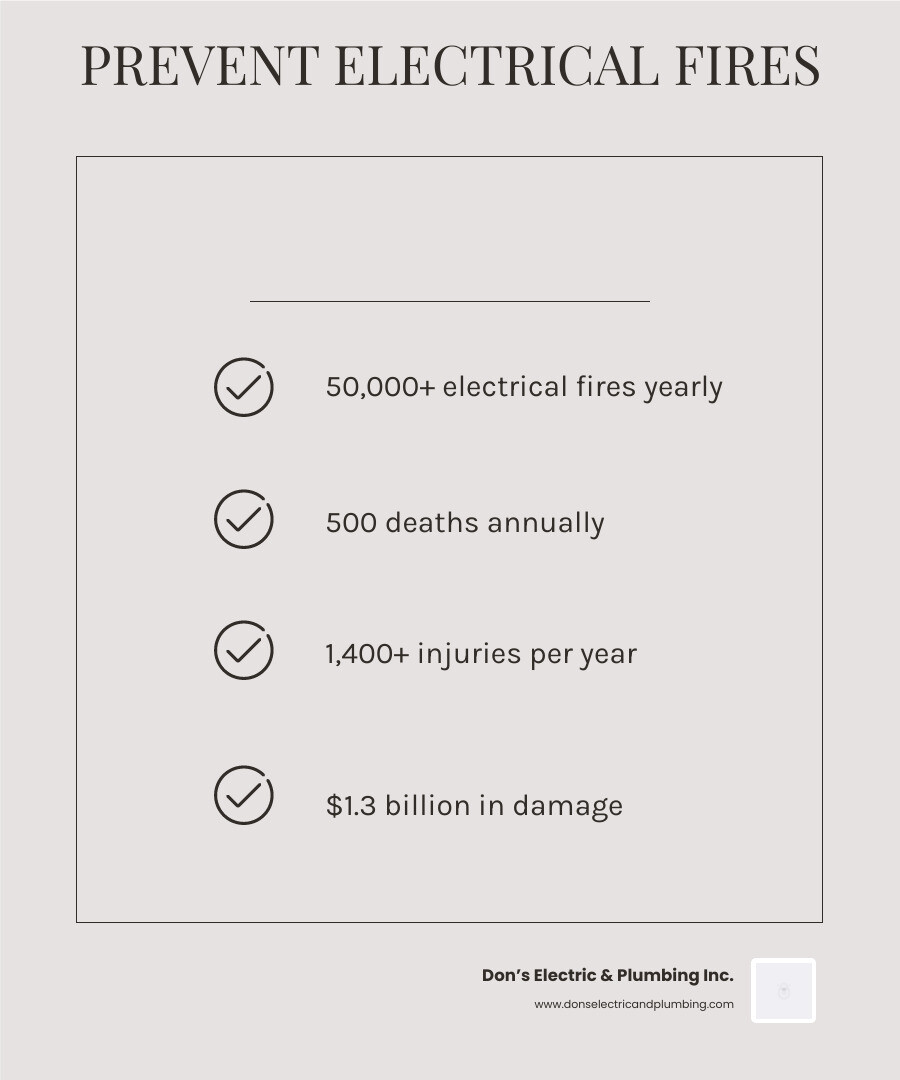
Every year, more than 50,000 electrical fires break out in U.S. homes — that’s roughly one every ten minutes. These fires kill nearly 500 people, injure over 1,400 more, and cause an estimated $1.3 billion in property damage annually. And the unsettling truth? Most of them are preventable.
Electrical fires don’t always start with a dramatic spark. They often begin quietly — inside a wall, behind an outlet, or deep in an aging panel — long before anyone smells smoke. That’s what makes them so dangerous.
At Don’s Electric & Plumbing Inc., we help homeowners understand and address the electrical hazards hiding in plain sight. This guide walks you through the most common causes, warning signs, and proven prevention strategies so you can protect your home and the people in it.
Essential Tips on How to Prevent Electrical Fires in Your Home
When we talk about how to prevent electrical fires in your home, we have to start with the “invisible” dangers. Many of the 51,000 annual electrical fires reported to fire departments stem from arcing faults. An arc fault occurs when electricity jumps from one connection to another, often due to damaged wire insulation or loose connections. This creates intense heat—sometimes exceeding 10,000 degrees Fahrenheit—which can easily ignite surrounding wood framing or insulation.
In older homes throughout Montgomery and Schoharie Counties, the electrical systems weren’t designed to handle the sheer volume of gadgets we use today. Between our high-definition TVs, multiple computers, and kitchen gadgets, we are asking a lot of our wiring. If your home was built more than 20 years ago, it is highly likely your system is working overtime.
One of the most effective ways to stay safe is to invest in professional Electric service. A licensed electrician can evaluate your panel’s capacity and ensure that your home isn’t one “overload” away from a disaster. Electrical distribution and lighting equipment rank first in direct property damage among all fire causes. Taking a proactive approach isn’t just a recommendation; it’s a necessity for modern living.
Identifying Warning Signs of Electrical Hazards
Your home usually tries to tell you when something is wrong. The problem is that many of us have become “electrically deaf” to the warning signs. Have you ever noticed your lights dimming when the vacuum kicks on? Or perhaps you’ve walked past an outlet and caught a faint whiff of something like burning plastic, rubber, or even fish?
These aren’t just quirks of an old house; they are red flags. Here are the most common warning signs you should never ignore:
- Flickering or Dimming Lights: This often indicates a circuit is overloaded or there is a loose connection in the wiring.
- Buzzing or Sizzling Sounds: If you hear noise coming from an outlet or switch, it’s likely an arc fault in progress.
- Hot Outlets or Switch Plates: Electrical components should never feel warm to the touch. If they do, internal wiring is likely overheating.
- Discolored Outlets: Scorch marks or soot around the plug holes are a sign that the outlet has already experienced a small fire or extreme heat.
- Frequent Breaker Trips: A circuit breaker that trips repeatedly is doing its job, but it’s also telling you that the circuit is drawing more power than it can safely handle.
If you notice these signs while your air conditioner is running during a humid New York summer, it might be time for AC service to ensure your cooling system isn’t putting undue stress on a failing electrical circuit.
Upgrading Systems with Modern Safety Devices
Modern technology has given us incredible tools to fight fires before they even start. If your home still relies on old-fashioned fuses or standard breakers, you are missing out on layers of protection that are now required by the National Electrical Code (NEC).
AFCI Breakers (Arc-Fault Circuit Interrupters)
Standard breakers only trip when there is a short circuit or an overload. They are “blind” to arcing faults. AFCI breakers, however, use advanced electronics to “listen” to the electricity. If they detect the specific signature of a dangerous arc, they shut down the power instantly. Experts estimate that AFCIs could prevent up to 50% of the electrical fires that occur every year.
GFCI Outlets (Ground-Fault Circuit Interrupters)
You’ve likely seen these in your kitchen or bathroom—they’re the ones with the “Test” and “Reset” buttons. GFCIs are designed to prevent electrocution by detecting when electricity is escaping the circuit (like through water or a person). We recommend Electric installation for GFCIs in all “wet” areas, including basements, garages, and outdoor receptacles.
Tamper-Resistant (TR) Receptacles
If you have little ones running around, TR receptacles are a must. They look like standard outlets but feature internal shutters that only open when two prongs are inserted simultaneously. This prevents children from sticking keys or paperclips into the slots.
| Device Type | Primary Protection | Best Location |
|---|---|---|
| AFCI Breaker | Prevents fires from arcing faults | Main electrical panel |
| GFCI Outlet | Prevents shocks and electrocution | Kitchens, baths, outdoors |
| TR Receptacle | Prevents foreign object insertion | Throughout the home |
Safe Usage of Appliances and Electronics
We love our appliances, but they are often the culprits in residential fires. Major appliances like refrigerators, washing machines, and stoves draw a significant amount of power. The golden rule is simple: Always plug major appliances directly into a wall outlet. Never use an extension cord or a power strip for these high-draw items. The extra length of wire creates resistance, which generates heat and can lead to a fire.
Small appliances deserve respect, too. When you’re done with the toaster or the hair straightener, unplug it. Even when turned off, some devices can still draw “phantom” power or experience internal failures that lead to overheating. If you notice your furnace acting up or making strange noises, don’t just ignore it; professional Furnace service can ensure the electrical components of your heating system are safe and sound.
Best Practices for High-Wattage Appliances: How to Prevent Electrical Fires in Your Home
Space heaters are a common sight in Canajoharie and the surrounding areas during our freezing winters, but they are also incredibly dangerous if misused. They contribute to a huge percentage of home heating fires.
To stay safe, follow the 3-foot rule: keep everything that can burn—curtains, bedding, furniture, and even your pets—at least three feet away from the heater. Always place the heater on a flat, hard surface (not a rug) and choose models with an automatic tip-over shut-off.
Don’t forget your clothes dryer! Failure to clean lint filters is the leading cause of dryer fires. Lint is highly flammable and can easily ignite if the dryer’s heating element gets too hot due to restricted airflow. If your heating system is struggling to keep up, it might be tempting to over-use space heaters, but it’s much safer to call for Furnace repair to fix the root of the problem.
Managing Cords and Power Strips: How to Prevent Electrical Fires in Your Home
Extension cords are meant to be a temporary fix, not a permanent wiring solution. If you find yourself relying on them for weeks at a time, you need more outlets.
Here is how to manage your cords safely:
- Check for Damage: Discard any cord that is frayed, cracked, or has a loose plug. Never try to “fix” a cord with electrical tape.
- Avoid the “Daisy Chain”: Never plug one power strip into another. This is a surefire way to overload the circuit and cause a fire.
- Don’t Hide Cords: Running cords under rugs or behind heavy furniture can cause them to overheat because the heat can’t dissipate. It also makes them a trip hazard and subjects them to damage from foot traffic.
- Use Surge Protectors: For sensitive electronics like computers and TVs, use a high-quality surge protector. This helps shield your devices from voltage spikes that can cause internal damage.
If you’re struggling with dark corners or a lack of outlets, our Lighting service can help you design a safer, more efficient lighting plan that eliminates the need for messy cords.
Frequently Asked Questions about Electrical Safety
What are the warning signs of an electrical fire?
The most common warning signs include flickering or dimming lights, a persistent burning smell (often described as plastic or fishy), buzzing or sizzling sounds from your walls or outlets, and circuit breakers that trip frequently. You should also look for discolored or scorched outlets and feel for switch plates that are unusually warm. If you notice any of these, shut off the power to that circuit and call a professional immediately.
Can pests cause electrical fires?
Yes, absolutely. Rodents like mice, rats, and squirrels love to chew on things to keep their teeth sharp, and for some reason, the plastic insulation on electrical wiring is a favorite. When they strip the insulation, they leave bare wires exposed inside your walls or attic. This creates a massive fire risk due to arcing and short-circuiting. If you suspect you have “guests” in your attic, have an electrician perform an Electric service inspection to check for hidden damage.
Is aluminum wiring dangerous?
Aluminum wiring was commonly used in homes built between the late 1960s and mid-1970s. While aluminum is a good conductor, it expands and contracts more than copper, which can cause connections to loosen over time. These loose connections lead to overheating and potential fires. If your home has aluminum wiring, you don’t necessarily need to rip it all out, but you do need a professional Electric installation expert to inspect the connections and possibly use specialized connectors to make the system safe.
Conclusion
At the end of the day, how to prevent electrical fires in your home comes down to vigilance and professional maintenance. Your home is your sanctuary, and keeping it safe from electrical hazards is a responsibility we take seriously. From Montgomery County to Schoharie and beyond, we have seen how a few simple upgrades—like AFCI breakers or a thorough inspection—can provide priceless peace of mind.
Don’t wait for a spark or a smell to tell you there’s a problem. Whether you need a simple outlet replacement or a full system upgrade, the team at Don’s Electric & Plumbing Inc. is here to help. We’ve been serving our neighbors since 1984 with a 100% guarantee and emergency services when you need them most.
Ready to make your home a safer place? Schedule an estimate today and let our family take care of yours.