


Is Your Electrical Panel Trying to Tell You Something?
How to know if your electrical panel needs replacing is something every homeowner should understand — because the warning signs are often easy to spot, yet easy to ignore.
Here are the most common signs your panel may need replacing:
- Frequent tripped breakers that keep shutting off
- Flickering or dimming lights, especially when appliances start up
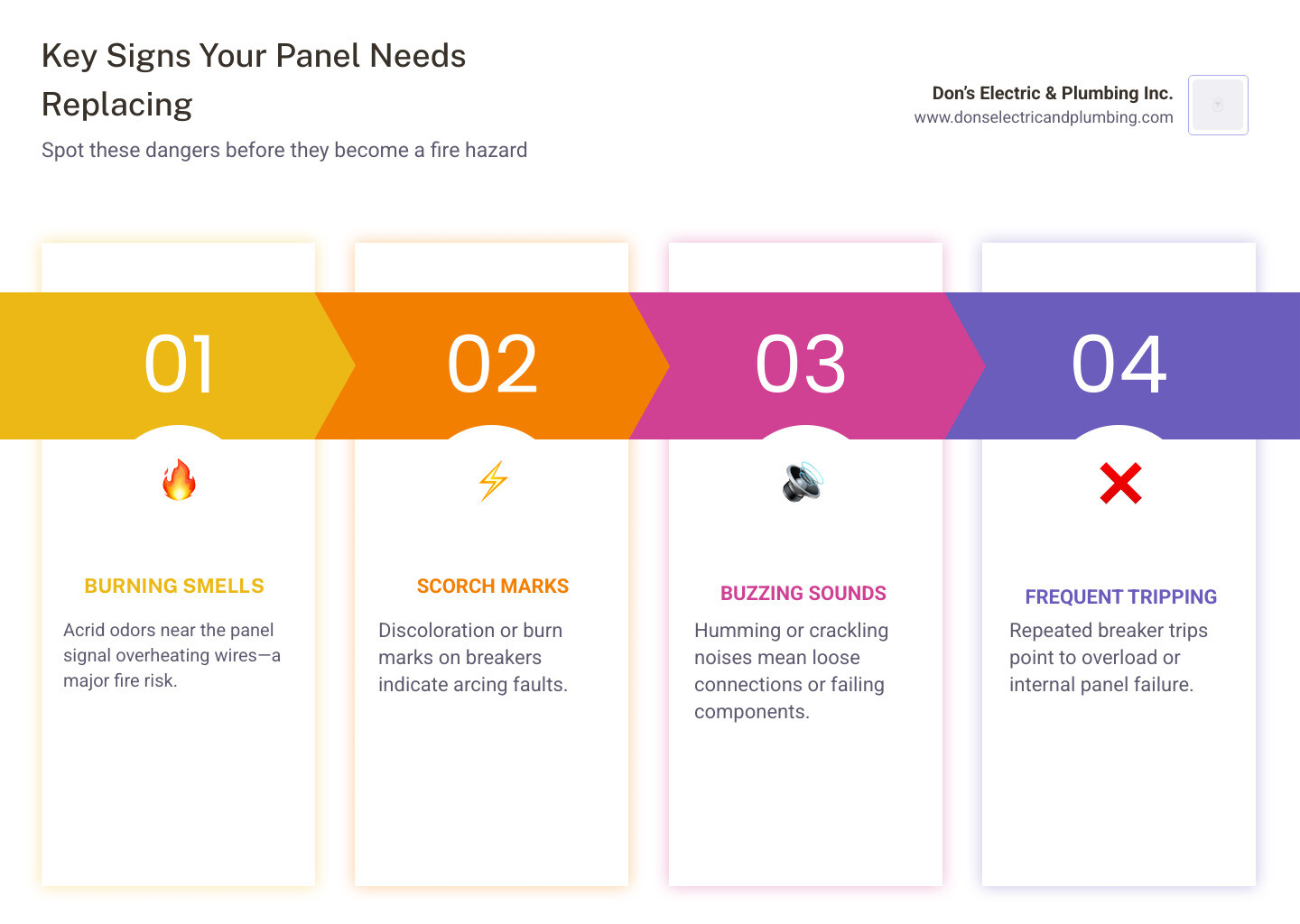
- Burning smells or scorch marks near the panel
- Buzzing or crackling sounds coming from the breaker box
- A panel that feels warm or hot to the touch
- Fuses instead of circuit breakers (a sign of an outdated system)
- A panel over 25-40 years old that hasn’t been inspected recently
- Known recalled brands like Federal Pacific Electric or Zinsco
Your electrical panel is the central hub that routes power to every outlet, light, and appliance in your home. When it starts to fail, it doesn’t just cause inconvenience — it can become a serious fire hazard. According to the National Fire Protection Association, an estimated 51,000 home electrical fires occur each year, many linked to failing electrical systems.
Most panels are built to last 25 to 40 years. But age isn’t the only factor. How your panel has been maintained, how much electrical demand your home places on it, and whether it was a quality unit to begin with all play a role in how long it safely performs.
If you’ve opened your breaker box and thought something doesn’t look right here, trust that instinct. This guide will walk you through exactly what to look for.
Understanding Your Home’s Electrical Hub
Think of your electrical panel as the “brain” of your home’s electrical system. It takes the high-voltage power from the utility line and distributes it into smaller, manageable “branch circuits” that feed your kitchen, bedrooms, and heavy appliances. Its most critical job, however, is safety. It acts as a traffic cop, ensuring that no circuit draws more power than its wires can safely handle.
Key Components of Your Panel
To understand if your panel is failing, it helps to know what’s inside:
- Main Breaker: The large switch at the top that shuts off power to the entire house.
- Circuit Breakers: The individual switches that “trip” (shut off) when a circuit is overloaded.
- Bus Bars: The conductive metal strips that carry power to the breakers.
- Neutral and Ground Bars: Safety components that return electricity to the source and protect you from shocks.
If you are noticing issues with these components, it might be time to look into our electric service in Canajoharie, NY to ensure everything is up to code.
Service Ampacity: 100-Amp vs. 200-Amp
The “ampacity” of your panel refers to the total volume of electricity it can handle at once. Many older homes in Montgomery and Schoharie Counties were built with 60-amp or 100-amp service. In the 1950s, that was plenty for a few lights and a radio. Today, with EVs, high-efficiency HVAC systems, and high-end kitchen gadgets, those panels are often gasping for air.
| Feature | 100-Amp Service | 200-Amp Service |
|---|---|---|
| Commonly Found In | Older or smaller homes | Modern homes & renovations |
| Wattage Capacity | Approx. 10,000 watts | Approx. 20,000 watts |
| Capacity for Additions | Limited; often full | High; room for EV chargers/AC |
| Modern Standard | Minimum for small homes | Standard for modern living |
How to know if your electrical panel needs replacing: 7 Telltale Signs
Recognizing how to know if your electrical panel needs replacing often starts with paying attention to how your home “behaves.” If your house feels like it’s struggling to keep up with your daily routine, your panel is likely the culprit.
1. Frequent Tripping Breakers
A circuit breaker is designed to trip when it detects an overload. If you find yourself walking to the basement or garage once a week to flip a switch back on, your panel is telling you it’s overloaded. This isn’t just a nuisance; it’s a sign that the internal components are wearing out from constant heat and stress.
2. Flickering or Dimming Lights
Do your kitchen lights dim for a split second when the refrigerator kicks on? Or perhaps the living room lamps flicker when you start the vacuum? This indicates that your appliances are “stealing” power from other circuits because the panel cannot distribute enough current simultaneously.
3. The Use of Too Many Extension Cords
If your home lacks enough outlets, you might be relying on a web of power strips and extension cords. This is often a sign that your original electrical system (and the panel feeding it) wasn’t designed for modern life. Upgrading your panel allows for the electric installation in Canajoharie, NY of new, dedicated circuits and outlets where you actually need them.
4. Physical Damage or Corrosion
Living in areas like Little Falls or Sharon Springs means dealing with humidity and temperature swings. If you see rust on the panel box or white powdery corrosion on the breakers, moisture has compromised the system. Water and electricity are a recipe for disaster, and a corroded panel cannot reliably trip during a short circuit.
5. Overheating and Warmth
A healthy electrical panel should be cool to the touch. If you place your hand on the cover and feel heat emanating from within, it’s a major red flag. This usually points to loose connections or a breaker that is failing to trip despite being overloaded.
6. Strange Noises
Electricity should be silent. If you hear buzzing, hissing, or crackling sounds coming from the breaker box, it’s likely “arcing.” This happens when electricity jumps between connections, creating intense heat that can easily start a fire.
7. Struggling Appliances
If your microwave takes longer than usual to heat food or your dryer doesn’t seem to get as hot as it used to, they might not be getting the full voltage they require. An outdated panel can cause “voltage drops” that shorten the lifespan of your expensive appliances.
Age-related wear and how to know if your electrical panel needs replacing
The general rule of thumb is that an electrical panel has a lifespan of 25 to 40 years. If your home was built in the 1980s or earlier and has the original equipment, you are likely at the end of that safety window. Over decades, the spring-loaded mechanisms inside breakers can become stiff or “weld” shut, meaning they won’t shut off even during a dangerous power surge. Regular maintenance can extend this slightly, but eventually, the metal components simply fatigue.
Performance issues and how to know if your electrical panel needs replacing
Modern life demands more “juice” than ever before. In the past, a home might have one television and a refrigerator. Now, we have home offices with multiple monitors, smart home hubs, high-draw hair dryers, and perhaps a hot tub in the backyard. If your panel is original to a 30-year-old home, it simply wasn’t engineered for this level of consumption.
Dangerous Warning Signs and Outdated Technology
While some signs are just “warnings,” others are emergencies. If you notice a burning smell (often like melting plastic or ozone) near your panel, or see scorch marks around a specific breaker, shut off the main power and call us immediately. These are signs that a fire is already smoldering or imminent.
Recalled and Hazardous Brands
Sometimes, the brand of your panel alone is enough of a reason to replace it. Certain manufacturers produced panels that were later found to have significant design flaws:
- Federal Pacific Electric (FPE): Their “Stab-Lok” breakers are notorious for failing to trip, leading to thousands of fires.
- Zinsco: These panels often have bus bars that corrode and breakers that melt directly onto the bar, making them impossible to shut off in an emergency.
- Fuse Boxes: If you still have screw-in fuses, your system is at least 50-60 years old. Fuses themselves aren’t “broken,” but they are easily bypassed by homeowners using the wrong size fuse, which creates a massive fire risk.
Upgrading these systems is a priority for home safety and often a requirement for homeowners’ insurance. While we are looking at your panel, it is also a great time to evaluate your lighting service in Canajoharie, NY to ensure your new power supply is feeding modern, energy-efficient fixtures.
Frequently Asked Questions about Electrical Panels
How often should I have my electrical panel inspected?
We recommend a professional inspection every three to five years. However, if your home is more than 20 years old, an annual or biennial check-up is much safer. Our technicians look for loose connections, signs of arcing, and thermal hotspots that you can’t see with the naked eye. Regular inspections ensure your system stays compliant with the latest National Electrical Code (NEC) standards.
When should I upgrade my panel for new appliances?
You should consider an upgrade before you bring the new appliance home. Major “power hogs” that often require a panel upgrade include:
- Electric Vehicle (EV) Chargers: Most Level 2 chargers require a dedicated 40-50 amp circuit.
- Central Air Conditioning: If you’re switching from window units to a central HVAC system, the draw is significantly higher.
- Tankless Water Heaters: These can draw massive amounts of amperage instantaneously.
- Kitchen Remodels: Modern codes require more dedicated circuits for dishwashers, disposals, and microwaves.
Is age alone a reason to replace an electrical panel?
While a 40-year-old panel might still be “working,” it is likely “obsolete.” Think of it like a 40-year-old car; it might get you down the road, but it lacks airbags, anti-lock brakes, and modern efficiency. Older panels often lack AFCI (Arc Fault Circuit Interrupter) protection, which is now required by code to prevent fires caused by damaged wiring behind walls. Furthermore, many insurance companies in New York now refuse to cover homes with panels older than 30-40 years or those with recalled brands.
Conclusion
Understanding how to know if your electrical panel needs replacing is the first step in protecting your family and your investment. Whether you’re noticing flickering lights in Palatine or dealing with a 40-year-old fuse box in Sharon Springs, Don’s Electric & Plumbing Inc. is here to help.
Since 1984, we’ve been the trusted name for electrical, plumbing, and HVAC services throughout Montgomery, Schoharie, Herkimer, and Fulton Counties. As a family-owned and operated business, we treat your home like our own. We offer a 100% guarantee on our work, provide emergency services for those scary “middle of the night” electrical smells, and offer financing options to make essential safety upgrades manageable for every budget.
Don’t wait for a small spark to become a big problem. Ensure your home’s “brain” is healthy and ready for the future.
Schedule an estimate for your panel replacement with Don’s Electric & Plumbing Inc. today!