


Why Does My Circuit Breaker Keep Tripping? Here’s What’s Going On
Why does my circuit breaker keep tripping is one of the most common electrical questions homeowners ask — and for good reason. It’s frustrating, it can happen at the worst times, and it’s not always obvious what’s causing it.
Here are the most common reasons your circuit breaker keeps tripping:
- Circuit overload — Too many appliances running on the same circuit at once
- Short circuit — A hot wire is touching a neutral wire, causing a sudden surge
- Ground fault — A hot wire is contacting a grounded surface, often near moisture
- Faulty appliance — A single device with damaged wiring is drawing unsafe current
- Worn-out breaker — An aging breaker that trips too easily or won’t stay reset
- Arc fault — Electricity is arcing across a loose or damaged connection
Most of the time, a tripping breaker is not random. It’s your electrical system doing exactly what it’s designed to do — cutting power before something goes wrong. That’s actually a good thing. But if it keeps happening, that’s a signal worth paying attention to.
The sections below will walk you through each cause, how to spot it, and what to do next.
What is a Circuit Breaker and How Does It Work?
To understand why your power keeps cutting out, it helps to know what a circuit breaker actually is. Think of it as a gatekeeper. Its primary function is to monitor the flow of electricity through a specific circuit in your home. If that flow becomes too high or unsafe, the breaker “trips,” physically moving the switch to the “off” or “neutral” position to stop the current.
Without these devices, the wires in your walls could overheat, melt their insulation, and start a fire. At Don’s Electric & Plumbing Inc., we often tell our neighbors in Canajoharie and Montgomery County that a tripping breaker is a safety feature, not a malfunction. It is actively protecting your family from electrical fires and shocks.
Inside that little plastic box are two main mechanisms:
- Thermal Mechanism: This handles gradual overloads. If you pull too much current for too long, a bimetallic strip inside heats up and bends, eventually triggering the trip.
- Magnetic Trigger: This handles sudden, massive surges like short circuits. An electromagnet senses the rapid spike in current and pulls the trigger instantly.
Every circuit has a specific amperage capacity (usually 15 or 20 amps for standard rooms). When the demand exceeds that capacity, or when resistance drops too low due to a wire fault, the breaker steps in. If you are experiencing frequent power interruptions, you might need professional electrical services to determine if your panel is still up to the task of modern living.
Why Does My Circuit Breaker Keep Tripping?
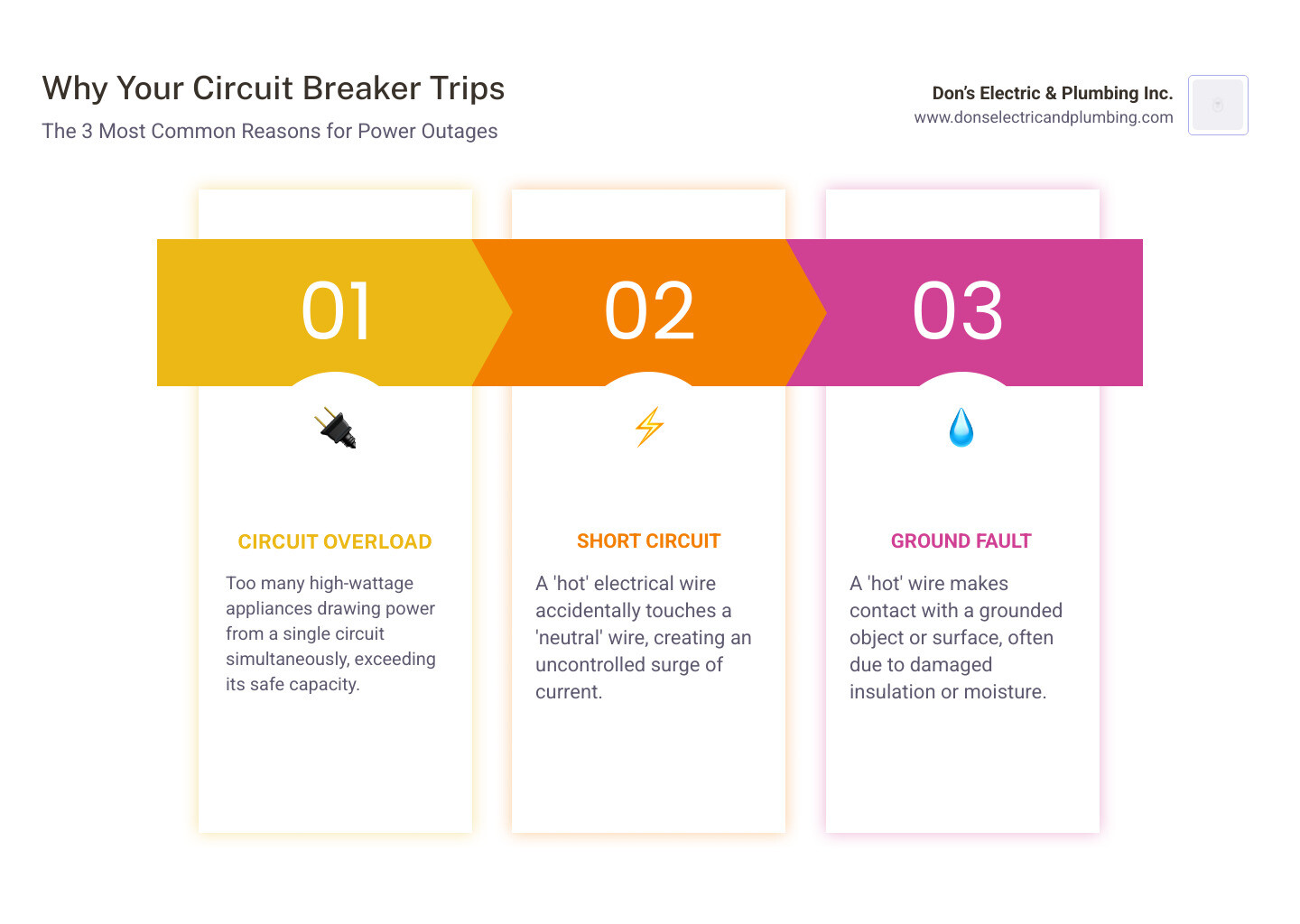
When you’re asking why does my circuit breaker keep tripping, you’re usually dealing with one of three main electrical faults. Identifying which one is the culprit is the first step to a permanent fix.
| Fault Type | What Happens | Common Sign |
|---|---|---|
| Circuit Overload | Too many devices drawing power at once. | Power goes out after you turn on a specific appliance. |
| Short Circuit | A “hot” wire touches a “neutral” wire. | A loud pop, a flash of light, or an instant trip upon reset. |
| Ground Fault | Electricity leaks to the ground (often via water). | Common in kitchens or bathrooms; often involves a GFCI outlet. |
Sometimes the issue isn’t a fault at all, but a lack of electrical installation capacity. Many older homes in the Mohawk Valley weren’t built for the sheer number of electronics we use today. If your panel is original to a house built 30 or 40 years ago, it may simply be overwhelmed.
Common Household Overloads: Why Does My Circuit Breaker Keep Tripping?
The most frequent cause of a tripped breaker is a simple overload. This happens when you try to pull 25 amps of electricity through a 15-amp circuit.
High-wattage appliances are the usual suspects. For example, a typical space heater draws about 1,500 watts. A hair dryer can draw up to 1,800 watts. If you run both at the same time on the same circuit, you are guaranteed to trip the breaker.
Common culprits include:
- Microwave ovens
- Toasters and coffee makers
- Portable air conditioners
- Vacuum cleaners
If your breaker trips every time the cooling kicks on, it might be time for an AC service check to ensure the unit isn’t drawing excessive power due to a mechanical struggle. To prevent overloads, try to stagger the use of these devices or move them to different rooms that are on separate circuits.
Dangerous Faults: Why Does My Circuit Breaker Keep Tripping?
While an overload is a “usage” issue, short circuits and ground faults are “wiring” issues. These are significantly more dangerous.
Short Circuits occur when a “hot” wire (usually black) comes into contact with a “neutral” wire (usually white). This creates a path of very low resistance, allowing a massive amount of current to flow instantly. This can be caused by loose connections, damaged wire insulation, or even rodents chewing through wires in your attic or crawlspace.
Ground Faults are a specific type of short circuit where the electricity touches the ground wire (green or bare copper) or a grounded metal box. This is especially common in areas with moisture. If you have a leaky pipe near an outlet, you might need a plumbing repair just as much as an electrical one. This is why the National Electrical Code requires GFCI (Ground Fault Circuit Interrupter) outlets in kitchens, bathrooms, and outdoor areas—they trip in a fraction of a second to prevent electrocution.
Signs Your Circuit Breaker Has Gone Bad
Breakers don’t last forever. Most have a lifespan of about 20 to 30 years. If your breaker is old, it might start “nuisance tripping”—shutting off even when the load is perfectly safe.
How can you tell if the breaker itself is the problem? Look for these warning signs:
- Burning Smell: If you smell ozone or burnt plastic near the panel, shut off the main power immediately.
- Hot to the Touch: While breakers can be slightly warm, they should never be hot.
- Visible Scorch Marks: Dark soot or melted plastic on the breaker or the bus bar is a major red flag.
- Failure to Reset: If you flip the switch to “On” and it immediately flops back to the middle or “Off” position (with nothing plugged in), the internal mechanism is likely broken.
- Buzzing Sounds: A healthy breaker is silent. If it’s humming or crackling, it’s failing.
If your heating system seems to be the trigger during our cold New York winters, a furnace service can help determine if the blower motor is failing and causing the breaker to wear out prematurely.
How to Safely Reset and Troubleshoot Your Electrical Panel
When a breaker trips, don’t just rush to flip it back. Follow these steps to stay safe and find the root cause:
- Unplug Everything: Go to the area that lost power and unplug all devices. This prevents a “surge” when you turn the power back on and helps you identify if a specific appliance is the problem.
- Safety First: Wear safety goggles if you have them. Stand to the side of the panel rather than directly in front of it. This protects you in the rare event of an arc flash.
- The “Full Off” Maneuver: A tripped breaker usually sits in the middle. You cannot just flip it to “On.” You must first push it firmly to the “Off” position until you hear a click, then flip it back to “On.”
- The Test: Plug your devices back in one by one. If the breaker trips the moment you plug in the toaster, you’ve found your culprit!
For long-term solutions, consider installing dedicated circuits for high-power items like refrigerators, space heaters, or new lighting services. This ensures that one heavy-duty appliance isn’t sharing “juice” with five other outlets.
Frequently Asked Questions
Is it dangerous if my breaker keeps tripping?
Yes, it can be. While the tripping itself is a safety action, the reason it’s tripping could be a fire hazard. Repeatedly resetting a breaker without fixing the underlying issue can lead to an arc flash—a dangerous electrical explosion—or permanent damage to your home’s wiring. If you notice burning odors or the panel feels hot, do not keep resetting it.
Which appliances are most likely to trip a breaker?
High-draw appliances and those with large motors are the most common offenders. This includes refrigerators, space heaters, hair dryers, and HVAC compressors. HVAC units are notorious because they require a “startup surge” that can be 3 to 4 times their normal running wattage. If your cooling system is constantly tripping the breaker, you might need a professional AC installation update or a hard-start kit.
When should I call a professional electrician?
You should call us at Don’s Electric & Plumbing Inc. if:
- The breaker trips immediately after being reset.
- You see sparks, smoke, or scorch marks.
- You hear buzzing or crackling from the panel.
- Your lights flicker when large appliances turn on.
- You have an older home with aluminum wiring.
- You are relying on extension cords for basic daily needs.
Sometimes the issue is deeper than a single breaker. You might need a furnace repair if a short circuit in the heating system is back-feeding into your panel, or a full panel upgrade to handle your home’s modern electrical load.
Conclusion
Understanding why does my circuit breaker keep tripping is essential for keeping your home safe and functional. Whether it’s a simple case of running the microwave and the toaster at the same time or a more serious issue like a ground fault, ignoring the signs can lead to costly damage or safety risks.
At Don’s Electric & Plumbing Inc., we’ve been serving our neighbors in Canajoharie, NY, and the surrounding counties since 1984. As a family-owned and operated business, we take your safety personally. We offer a 100% guarantee on our work, emergency services for those middle-of-the-night scares, and financing options to help you get your electrical system up to code without the stress.
Don’t let a tripping breaker leave you in the dark. From Montgomery to Schoharie and Herkimer counties, our team is ready to help you find the cause and keep the lights on. Schedule an estimate today and let us give you the peace of mind you deserve.