


What to Do When Your Circuit Breaker Keeps Tripping
How to troubleshoot a tripping circuit breaker is something most homeowners will need to do at some point. Here is a quick overview of the steps:
- Locate the tripped breaker in your electrical panel — it will be in the middle or “off” position.
- Turn off and unplug all devices on that circuit.
- Reset the breaker by pushing it firmly to “off,” then back to “on.”
- Plug devices back in one at a time to identify what is causing the trip.
- Move high-wattage appliances to different circuits if the breaker trips again.
- Stop and call an electrician if the breaker trips immediately with nothing plugged in, or if you smell burning.
You are in the middle of making breakfast — coffee maker running, toaster going, microwave humming — and then click. The kitchen goes dark. Sound familiar? A tripping circuit breaker is one of the most common electrical problems homeowners run into, and the good news is that many causes are straightforward to diagnose yourself without picking up the phone right away.
Circuit breakers are safety devices. They are designed to shut off power when something is wrong, protecting your home from overheating wires and electrical fires. When a breaker trips, it is not a malfunction — it is the system doing exactly what it is supposed to do. The real question is: why did it trip, and what should you do next?
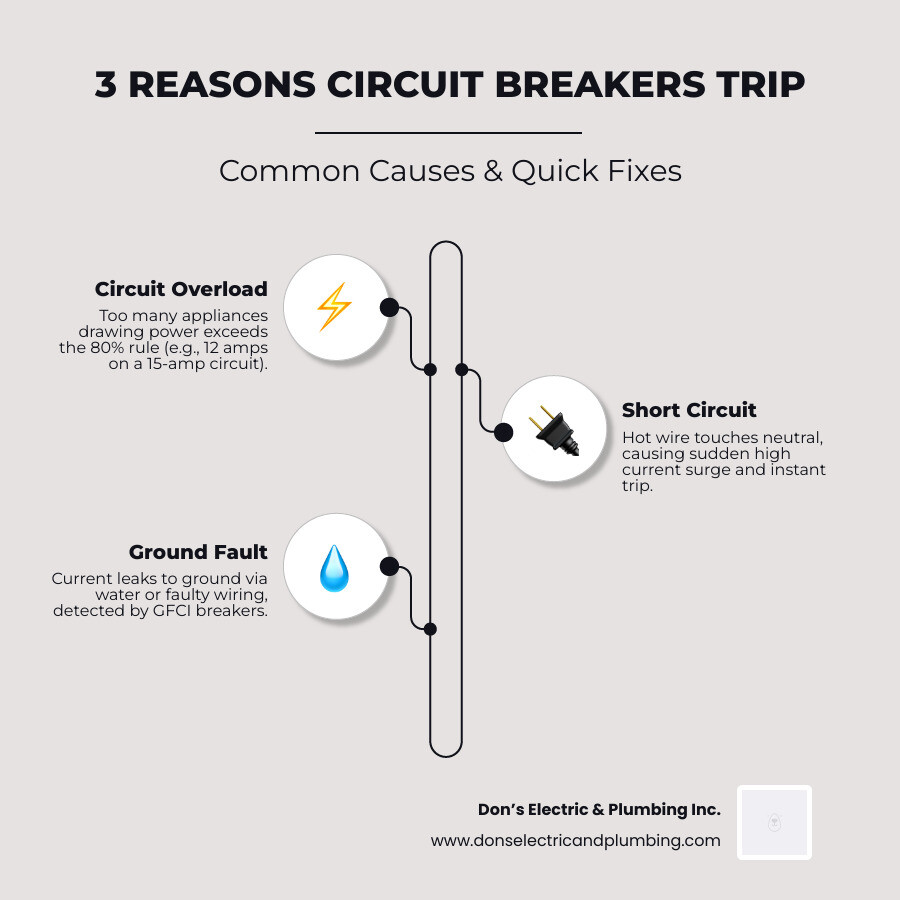
Most trips come down to three causes: too many devices drawing power at once (overload), a wiring problem (short circuit), or electricity taking an unintended path (ground fault). Each one has different signs and different solutions — and knowing which you are dealing with will tell you whether this is a quick DIY fix or a job for a licensed electrician.
Understanding Why Your Circuit Breaker Trips
Before we dive into the “how-to,” we need to understand the “why.” A circuit breaker is essentially a smart safety switch. Every circuit in your home has a specific amperage capacity, which is the maximum amount of electricity it can safely carry. Most standard room circuits are rated for 15 amps, while kitchens, bathrooms, and laundry rooms often have 20-amp circuits to handle heavier loads.
A key industry standard we follow is the 80% rule. For a circuit to run reliably without “nuisance tripping,” it should only carry a continuous load of 80% of its total capacity. This means a 15-amp breaker is really designed to support about 12 amps (roughly 1,800 watts) of constant power. When you exceed that limit, the breaker heats up and eventually “trips” to prevent the wires inside your walls from melting or starting a fire.
There are three primary reasons a breaker will cut power:
- Circuit Overload: This is the most common culprit. It happens when you have too many high-wattage appliances running on the same line. Think of it like a traffic jam; the “road” (the wire) can only handle so many “cars” (amps) at once.
- Short Circuit: This is more serious. It occurs when a “hot” wire touches a “neutral” wire. This creates a sudden, massive surge of electricity that forces the breaker to trip instantly to prevent a fire.
- Ground Fault: Similar to a short circuit, this happens when the hot wire touches a ground wire or a grounded portion of a junction box or appliance. This is especially common in areas with moisture, like kitchens and bathrooms.
To keep your home running smoothly, it helps to know which tools in your house draw the most power. If you are experiencing frequent issues, you may need to look into our electric service to ensure your panel is up to the task of modern living.
Common High-Wattage Appliances (The “Power Hogs”)
- Space Heaters: 1,500 watts (12.5 amps)
- Hair Dryers: 1,200–1,875 watts (10–15 amps)
- Microwaves: 600–1,200 watts (5–10 amps)
- Toasters/Toaster Ovens: 1,100–1,500 watts (9–12 amps)
- Coffee Makers: 1,000 watts (8.3 amps)
- Window AC Units: 500–1,500 watts (startup surges can be much higher)
How to Troubleshoot a Tripping Circuit Breaker Safely
Safety is our number one priority at Don’s Electric & Plumbing Inc. When you open that metal panel door, you are looking at the heart of your home’s electrical system. While resetting a switch is generally safe, you should always follow these basic precautions:
- Wear rubber-soled shoes: Never stand on a wet floor or work with wet hands when touching your electrical panel.
- The “One-Hand Rule”: When flipping a breaker, try to keep one hand behind your back or in your pocket. This reduces the risk of an electrical current passing through your chest in the unlikely event of a fault.
- Stand to the side: Don’t stand directly in front of the panel when flipping a switch; stand slightly to the side to protect your face and body.
Essential Tools for how to troubleshoot a tripping circuit breaker
You don’t need a heavy-duty contractor’s belt to do some basic sleuthing, but a few simple tools can make the process much easier:
- Flashlight: Most breaker panels are in dark basements or garages. You need clear visibility to see if a switch is slightly out of alignment.
- Non-contact Voltage Tester: This allows you to check if an outlet or wire is “live” without actually touching the metal components.
- Plug-in Outlet Tester: This inexpensive device can tell you if an outlet is wired correctly or if there is an open ground, which is vital for identifying ground faults.
If your troubleshooting reveals that you need more outlets or a dedicated line for a new appliance, we can help with professional electric installation.
Step-by-Step Guide on how to troubleshoot a tripping circuit breaker
Step 1: Identify the Tripped Breaker Open your panel and look for a switch that isn’t lined up with the others. It will usually be stuck in the middle position, or it might have a red or orange indicator showing it has tripped.
Step 2: Unplug and Turn Off Everything Before you touch the breaker, go to the rooms that lost power. Unplug every single lamp, toaster, and computer. Turn off every light switch. This ensures that when you reset the breaker, it doesn’t immediately face a massive “startup load” that could trip it again.
Step 3: The “Firm Reset” A common mistake is trying to flip a tripped breaker directly to “ON.” It won’t stay. You must first push the switch firmly to the OFF position until you hear a distinct click. Then, flip it back to ON.
Step 4: Isolate the Circuit If the breaker stays on with nothing plugged in, the problem is likely an overload or a faulty appliance. If it trips immediately with nothing plugged in, you likely have a short circuit in your home’s wiring.
Step 5: Identify the Culprit One by one, plug your devices back in and turn them on. If the breaker trips the moment you turn on the microwave, you’ve found your problem! It’s either a faulty microwave or that specific circuit simply can’t handle the power draw.
Identifying Overloads, Short Circuits, and Ground Faults
Knowing the difference between these three issues can save you hours of frustration. Use this table as a quick reference guide:
| Feature | Circuit Overload | Short Circuit | Ground Fault |
|---|---|---|---|
| Primary Cause | Too many appliances running at once. | Hot wire touching a Neutral wire. | Hot wire touching a Ground/Moisture. |
| Warning Signs | Dimming lights; warm outlets; breaker trips after several minutes. | Sudden “pop”; burning smell; visible scorch marks on outlets. | Often happens in bathrooms/kitchens; trips immediately or after a few seconds. |
| The Fix | Redistribute appliances to other circuits; stagger usage. | Inspect for frayed cords; call a pro for wiring repair. | Reset GFCI outlets; dry out moisture; call a pro for grounding issues. |
The Short Circuit “Pop” A short circuit is often dramatic. You might hear a “pop” or see a small spark. This usually happens because of a loose connection in an outlet or because a rodent has chewed through the insulation behind your walls. If you see a scorched electrical outlet, do not attempt to use it. This is a clear sign of a short circuit that needs professional attention.
The Ground Fault Mystery Ground faults are common in our area, especially in older homes in Montgomery or Schoharie County where moisture can seep into outlets during heavy rains. If your breaker trips only when it’s humid or when you use a specific outdoor outlet, a ground fault is the likely suspect.
When to Stop DIY Troubleshooting and Call for Help
We love helping our neighbors in Canajoharie and the surrounding areas save money by doing things themselves, but electrical work has a “danger zone.” You should stop what you are doing and call a licensed electrician at Don’s Electric & Plumbing Inc. if you encounter any of the following:
- The Burning Smell: If you smell an ozone or “fishy” plastic burning scent near your panel or an outlet, turn off the main breaker immediately. This is a fire in the making.
- Buzzing or Sizzling: Your electrical system should be silent. If you hear a buzzing or crackling sound (arcing), it means electricity is jumping through the air between loose connections.
- Hot to the Touch: If the breaker panel door or an individual breaker feels hot, it is a sign of a serious internal failure.
- Immediate Re-tripping: If you have unplugged everything and the breaker still won’t stay in the “ON” position, there is a fault in the permanent wiring of your home.
- Outdated Panels: If your home still uses a fuse box or features a panel from brands like Federal Pacific Electric (FPE) or Zinsco, you are at a higher risk. These panels are notorious for failing to trip during a fault, which can lead to house fires.
If you are noticing flickering lights or your breakers are constantly struggling, it might be time for a lighting service or a full panel inspection to ensure your home meets modern safety codes.
Frequently Asked Questions about Breaker Troubleshooting
Why does my breaker trip with nothing plugged in?
This usually indicates a “hard fault” in the wiring itself. It could be a short circuit where two wires are touching inside a wall, or a ground fault where a wire has come loose and is touching the metal box. Because this involves the hidden wiring of your home, it is not a DIY fix.
How many times can a circuit breaker trip before it goes bad?
While breakers are designed to trip thousands of times over their lifespan, they do wear out. Every time a breaker trips, a small amount of internal wear occurs. If a breaker has tripped dozens of times due to a persistent overload, the internal spring mechanism can weaken, making it trip more easily (nuisance tripping) or, worse, causing it to fail and stay on during a dangerous surge.
What is the difference between a standard breaker and a GFCI?
A standard breaker protects the wire from overheating. A GFCI (Ground Fault Circuit Interrupter) is designed to protect people. GFCIs are much more sensitive; they detect tiny imbalances in the current (as little as 4-6 milliamps) and shut off power in 1/40th of a second to prevent a lethal electric shock. You’ll usually find these in your kitchen, bathroom, and basement.
Conclusion
At Don’s Electric & Plumbing Inc., we’ve been serving the Mohawk Valley and surrounding counties since 1984. As a family-owned and operated business, we know how important it is to keep your home safe and functional. Whether you are in Canajoharie, Sharon Springs, or Little Falls, we are here to provide the expert support you need when DIY troubleshooting isn’t enough.
We stand behind our work with a 100% guarantee and offer emergency services for those moments when the power just won’t stay on. If you’ve followed these steps and your breaker is still giving you trouble, don’t take risks with your family’s safety.
Ready to get your home’s electrical system back in top shape? Schedule an estimate with us today, and let our experienced team handle the heavy lifting!