


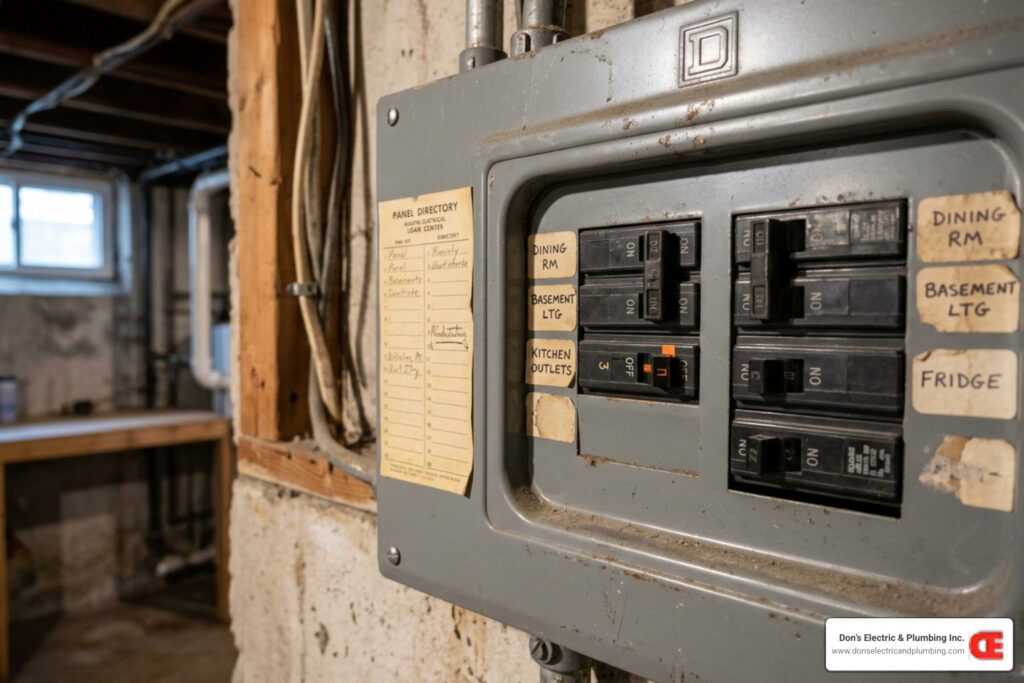
Why Circuit Breakers Keep Tripping in Older Homes
Circuit breaker tripping in older homes causes more frustration than most homeowners expect — and it happens a lot in places like Canajoharie, NY, where many houses are decades old and still running on their original electrical systems.
The most common reasons older home breakers keep tripping are:
- Overloaded circuits — too many appliances drawing power from one circuit
- Short circuits — damaged or deteriorating wiring causing a sudden surge
- Ground faults — electricity escaping its intended path, often near moisture
- Arc faults — electricity jumping across gaps in old or frayed wiring
- Aging breakers — worn internal parts that trip too easily or fail to reset
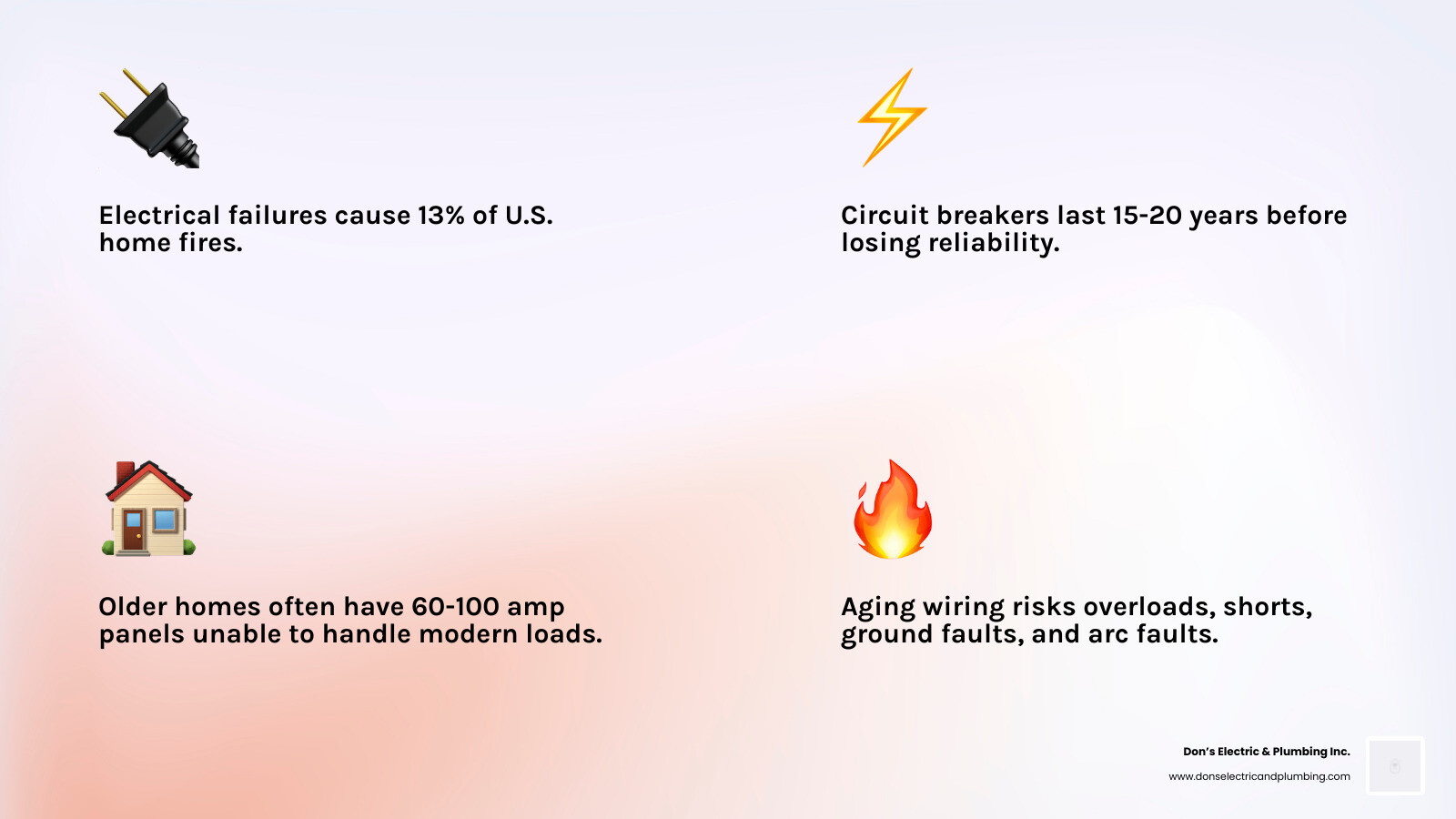
- Outdated panels — 60–100 amp systems not built for modern power demands
- Deteriorated wiring — insulation breakdown, loose connections, or aluminum wiring issues
Here’s the thing: your breaker isn’t the problem. It’s doing exactly what it was designed to do — cut power before something dangerous happens. The real issue is what’s forcing it to trip in the first place.
Electrical failures are already responsible for roughly 13% of residential fires nationwide. In older homes, where wiring and breakers may be 30, 40, or even 50 years old, that risk is even harder to ignore. Circuit breakers typically last 15–20 years before they start losing reliability, and many homes in this area have never had their panels updated.
If your breaker keeps tripping, your home is telling you something needs a closer look.
Common Circuit Breaker Tripping in Older Homes Causes
When we visit homes in Montgomery or Schoharie County, we often find that the “mysterious” power outage is actually a very predictable safety response. Understanding why your breaker is clicking off is the first step toward a safer home.
1. The Classic Circuit Overload
This is the number one reason for a trip. Think of your circuit like a one-lane road. If you try to cram three semi-trucks down it at once, traffic stops. In a 1950s kitchen, one circuit might have been enough for a toaster and a lightbulb. Today, that same circuit is trying to power a high-wattage microwave (1,000+ watts), a coffee maker (600–1,200 watts), and an air fryer (1,500 watts).
A standard 15-amp circuit can handle about 1,800 watts total. If you run the microwave and the air fryer at the same time, you are asking for over 2,500 watts. The breaker heats up, the internal strip bends, and click—the power cuts out to prevent the wires in your walls from melting.
2. Short Circuits
A short circuit is more serious. This happens when a “hot” wire touches a “neutral” wire. This creates an immediate, massive surge of electricity. You might hear a loud pop, see a spark, or even notice a faint smell of ozone or burning. In older homes, this is often caused by cracked wire insulation or a loose connection behind an outlet.
3. Ground Faults
Similar to a short circuit, a ground fault happens when electricity takes an unintended path to the ground. This often occurs in “wet” areas like bathrooms, kitchens, or basements. If water gets into an outlet or a wire touches a metal junction box, the breaker trips instantly. This is a critical safety feature designed to prevent you from getting a dangerous electrical shock.
4. Arc Faults
An arc fault is essentially a spark jumping across a gap. This happens when wires are frayed, loose, or damaged by a stray nail during a DIY project. These “arcs” create intense heat that can easily start a fire behind your drywall. Modern AFCI (Arc Fault Circuit Interrupter) breakers are designed to catch these, but many older homes in our area lack this protection.
If you are dealing with persistent power issues, it might be time to look into professional electrical services to diagnose the root cause.
Why Aging Electrical Systems Struggle with Modern Power Demands
The homes in Canajoharie and Sharon Springs have incredible character, but their electrical “skeletons” weren’t built for the 21st century. When these houses were constructed, “high tech” meant a radio and a refrigerator.
Today, we have home offices with multiple monitors, high-efficiency HVAC systems, electric vehicle chargers, and dozens of smart devices. Most homes built before the 1990s were equipped with 60-amp or 100-amp service panels. By modern standards, that is barely enough to get by. Most new homes today start at 200-amp service to handle the load.
Electrical aging typically becomes a major factor after 25 to 30 years. At this point, the components simply don’t work as well as they used to. If you are adding new appliances or a finished basement, you likely need to discuss electrical installations to ensure your panel can keep up.
Outdated Wiring and Circuit Breaker Tripping in Older Homes Causes
As wiring ages, it becomes brittle. In very old homes, you might still find knob-and-tube wiring, which lacks a ground wire entirely. In homes from the 1960s and 70s, aluminum wiring was common. Aluminum expands and contracts more than copper, which often leads to loose connections at outlets and switches.
We also see a lot of “environmental” damage in rural New York homes. Rodents love the taste of old wire insulation, and once they chew through that protective coating, you have a recipe for constant short circuits and fire hazards.
How Equipment Wear Leads to Circuit Breaker Tripping in Older Homes Causes
Circuit breakers are mechanical devices. Inside, they have springs and bimetallic strips that react to heat. Over 15–20 years, these parts can weaken. A “soft” breaker might start tripping even when the load is perfectly normal because the internal spring has lost its tension.
Corrosion is another silent killer. In damp basements across Herkimer and Montgomery Counties, moisture can cause rust to form on the bus bar (the metal rail the breakers sit on). This creates resistance, which creates heat, which—you guessed it—causes the breaker to trip. Interestingly, a struggling electrical system can even impact your other appliances. For example, if your AC unit isn’t getting steady power, it might require more frequent AC repair services because the motor is being stressed by “dirty” or inconsistent electricity.
Warning Signs Your Older Home Needs an Electrical Inspection
Not every trip is a simple overload. Sometimes, your panel is screaming for help. We’ve put together a quick guide to help you distinguish between a minor annoyance and a potential emergency.
| Symptom | What It Likely Means | Urgency Level |
|---|---|---|
| Breaker trips when you use the toaster and microwave | Simple circuit overload. | Low (Manage your load) |
| Breaker trips immediately every time you reset it | A direct short circuit or a failed breaker. | High (Call a pro) |
| A burning smell near the panel or an outlet | Wires are melting or arcing. | EMERGENCY (Turn off main power) |
| Outlets feel warm to the touch | Loose connections or undersized wiring. | High (Inspection needed) |
| Flickering lights when the fridge or AC kicks on | Your panel is at its capacity limit. | Medium (Upgrade recommended) |
| Buzzing or crackling sounds from the wall | Active arc fault occurring. | EMERGENCY |
If you notice your lights dimming every time a large appliance starts, it’s a sign that the voltage is dropping because the system is overtaxed. This can eventually damage sensitive electronics like LED fixtures, which might lead you to need lighting services more often than necessary.
How to Safely Troubleshoot and Reset a Tripped Breaker
If a breaker trips, don’t panic. Follow these steps to safely restore power and figure out what happened:
- Unplug the Culprits: Go to the area that lost power. Unplug everything that was running when the “click” happened. This reduces the “startup load” when you flip the switch back.
- Locate the Panel: Head to your breaker box. Look for a switch that isn’t lined up with the others. It will usually be stuck in the middle position, or moved toward the “Off” side. Some breakers have a small red or orange window to show they’ve tripped.
- The “Full Off” Rule: You cannot just flip a tripped breaker back to “On.” You must first push it firmly to the OFF position until you hear a click.
- Flip to “On”: Now, flip it back to the ON position.
- Test One by One: Go back and plug your devices in one at a time. If the breaker trips the second you plug in the vacuum, you’ve found your faulty appliance.
Safety Tip: Always stand to the side of the panel when flipping a breaker, and never use a tool or a screwdriver to force a switch to stay in the “On” position. If it won’t stay on, there is a dangerous fault that needs professional attention.
In some cases, homeowners find that their HVAC system is what’s causing the trip. If your air conditioner trips the breaker every time it tries to start, you might need AC installation services to replace an aging, power-hungry unit with a modern, energy-efficient model.
Recommended Upgrades for Older Electrical Panels
If you find yourself walking to the basement once a week to reset a switch, it’s time to stop patching the problem and start fixing it. Modernizing an older home’s electrical system isn’t just about convenience; it’s about safety and home value.
- Panel Replacement: Upgrading from a 100-amp to a 200-amp panel gives your home the “breathing room” it needs for modern life.
- Dedicated Circuits: High-demand appliances like refrigerators, dishwashers, and space heaters should each have their own dedicated line. This prevents the “microwave-trips-the-living-room-lights” scenario.
- GFCI Protection: Installing Ground Fault Circuit Interrupter outlets in your kitchen, bathroom, and garage is now required by code and saves lives by preventing electrocution.
- AFCI Breakers: These “smart” breakers detect dangerous arcing before a fire can start.
- Whole-Home Surge Protection: Protect your expensive computers and TVs from the power surges that often occur during New York summer storms.
Don’t forget that your heating system relies on your electrical panel too. If you’re upgrading your home’s infrastructure, it’s a great time to ensure your furnace service includes a check of the electrical connections to keep you warm all winter without any unexpected outages.
Frequently Asked Questions about Older Home Electrical Issues
How long do circuit breakers typically last?
Most manufacturers state that breakers last between 15 and 20 years. However, in a controlled environment, they can last longer. In the real world—with dust, humidity, and varying electrical loads—we recommend having a professional inspection if your breakers are over 25 years old. If they feel “spongy” or won’t click firmly into place, they have reached the end of their lifespan.
Is it dangerous if my breaker keeps tripping?
Yes. While the breaker is doing its job by tripping, the reason it is tripping is the danger. Repeated tripping means that heat is building up somewhere in your system. If you keep resetting it without fixing the underlying issue, you are essentially ignoring a smoke alarm. Over time, this heat can degrade wire insulation and lead to a fire.
When should I stop troubleshooting and call a professional?
You should call a pro if:
- The breaker trips immediately after being reset.
- You smell burning or see scorch marks on an outlet.
- The breaker feels hot to the touch.
- The power goes out in half the house but no breakers are tripped.
- You are still using a fuse box instead of a modern circuit breaker panel.
Conclusion
Living in a historic home in Canajoharie or Little Falls is a point of pride, but it shouldn’t come with the stress of constant power failures. Circuit breaker tripping in older homes causes range from simple overloads to dangerous hidden wiring faults, but they all deserve your attention.
At Don’s Electric & Plumbing Inc., we’ve been serving our neighbors in Montgomery, Fulton, and Schoharie Counties since 1984. As a family-owned and operated business, we understand that your home’s safety is your top priority. That’s why we offer a 100% guarantee on our work, emergency services for those times when the lights go out at 2:00 AM, and financing options to make necessary upgrades manageable.
Don’t wait for a small “click” to turn into a big problem. Schedule an electrical evaluation today and let us give you the peace of mind that comes with a safe, modern electrical system.