


Is a Tripping Circuit Breaker Dangerous? Here’s What Every Homeowner Should Know
Is a tripping circuit breaker dangerous? The short answer is: it depends — but repeated tripping should never be ignored.
A single trip is usually just your electrical system doing its job. But when the same breaker keeps tripping, it’s a warning sign of an underlying problem that can put your home and family at real risk.
Quick answer for homeowners:
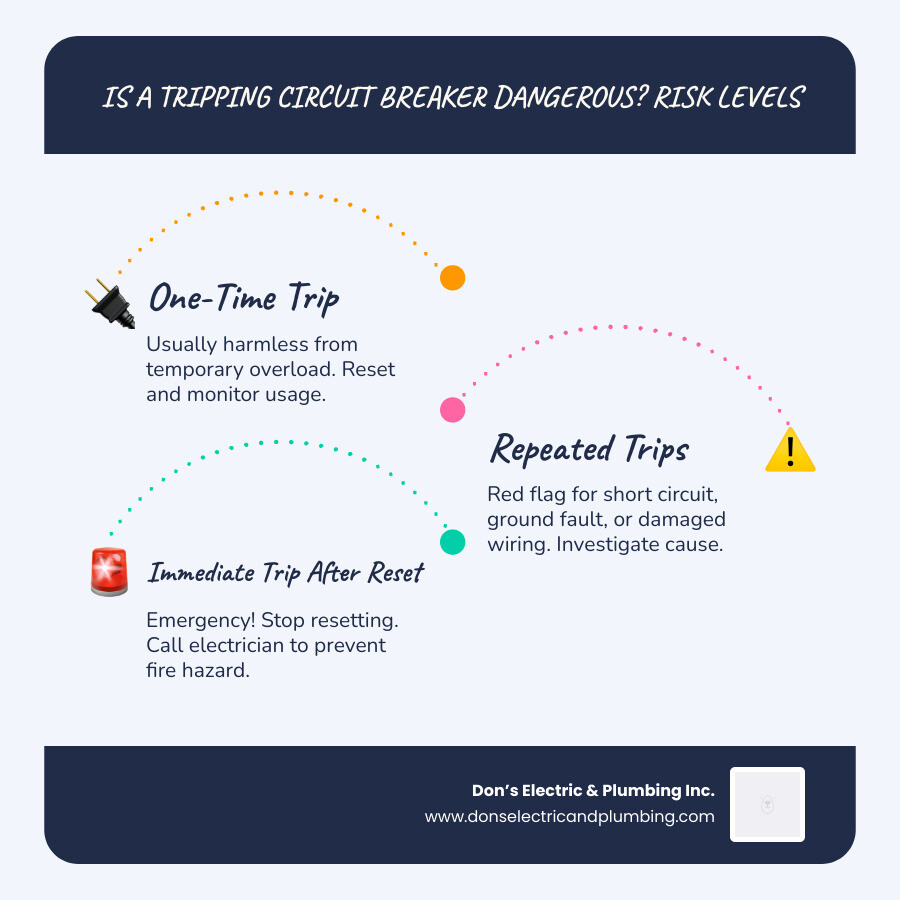
- One-time trip — Often harmless. Usually caused by a temporary overload (too many devices at once). Reset and monitor.
- Repeated trips on the same circuit — A red flag. Could signal a short circuit, ground fault, faulty appliance, or damaged wiring.
- Breaker trips immediately after reset — Stop resetting. This is an emergency. Call a licensed electrician right away.
- Tripping with burning smell, scorch marks, or buzzing sounds — Serious danger. Shut off the main breaker and call for help immediately.
The real danger isn’t the breaker tripping — it’s the fault that’s causing it to trip. Circuit breakers are a safety mechanism, designed to cut power before wiring overheats and ignites. When you keep resetting a tripping breaker without fixing the root cause, you’re bypassing that protection. And according to electrical safety data, nearly 40% of home fires in residential settings are linked to electrical faults — many of which start silently behind walls or inside switchboards.
If your breaker keeps tripping at home in Canajoharie, NY, the guide below walks you through everything you need to know — from causes and warning signs to safe troubleshooting and when to call a professional.
Understanding the Role of Your Circuit Breaker
Think of your circuit breaker as a loyal, albeit slightly grumpy, bodyguard for your home. Its entire job is to watch the flow of electricity and “tackle” the power (shut it off) if things get out of hand. Without these breakers, the wires in your walls could carry so much electricity that they would glow red hot, melt their insulation, and eventually set your house on fire.
Inside your electrical panel, each breaker is responsible for a specific “circuit” or area of your home. When the electrical current exceeds the breaker’s rated capacity—usually 15 or 20 amps for standard wall outlets—the internal mechanism triggers. This is known as overcurrent protection.
Most modern breakers use a “thermal-magnetic” trip system:
- Thermal Trip: This handles slow, steady overloads. If you plug in a space heater and a hair dryer on the same circuit, the heat builds up in a bimetallic strip inside the breaker until it bends enough to trip the switch.
- Magnetic Trip: This handles sudden, massive surges, like a short circuit. An electromagnet inside the breaker senses the spike and trips the switch almost instantly.
In our neck of the woods, from Montgomery County to Schoharie County, we see three main types of breakers:
- Standard Breakers: These protect against overloads and short circuits.
- GFCI (Ground Fault Circuit Interrupter): These are extra sensitive to “leaks” of electricity. They are required in wet areas like kitchens, bathrooms, and outdoor outlets to prevent electrical shock.
- AFCI (Arc Fault Circuit Interrupter): These are designed to detect dangerous “arcing”—where electricity jumps across a gap (like a frayed wire). These are vital for preventing fires in bedrooms and living areas.
If your bodyguard is constantly jumping into action, it’s time to look at our professional electrical services to find out why he’s so worried.
Common Culprits: Why Your Breaker Keeps Tripping
When a breaker trips, it’s usually for one of four reasons. Understanding these can help you determine is a tripping circuit breaker dangerous in your specific situation.
1. Circuit Overload
This is the most common and least “scary” cause. It happens when you simply ask the circuit to do more than it was designed for. If you’re running a microwave, a toaster, and a coffee maker all on the same kitchen circuit, you’re likely pushing past that 20-amp limit.
2. Short Circuit
This is more serious. A short circuit happens when a “hot” wire touches a “neutral” wire. This creates a path of very low resistance, allowing a massive amount of current to flow instantly. This often happens due to a loose connection, a damaged cord, or even a curious rodent chewing on wires in your attic.
3. Ground Fault
Similar to a short circuit, a ground fault occurs when the “hot” wire touches the ground wire or a grounded part of an appliance (like the metal frame). This is especially common in damp areas. If your AC unit is acting up and tripping the breaker during a humid NY summer, you might need our AC repair service to check for internal faults.
4. Arc Fault
Arcing happens when wires are damaged or loose, causing electricity to “spark” across a gap. This creates intense heat that can ignite nearby wood or insulation without ever blowing a standard breaker.
| Feature | Circuit Overload | Short Circuit / Ground Fault |
|---|---|---|
| Cause | Too many devices running | Wires touching where they shouldn’t |
| Warning Signs | Flickering lights, warm outlets | Instant trip, pop sound, burning smell |
| Risk Level | Moderate (if ignored) | High (Fire and Shock risk) |
| Solution | Unplug devices / Add circuit | Professional repair required |
Is a Tripping Circuit Breaker Dangerous?
The short answer is yes. While the act of tripping is a safety feature, the fact that it needs to trip means there is a hazard present.
The primary danger is an electrical fire. When a circuit is overloaded or shorted, the wires generate heat. If the breaker fails to trip—or if you keep forcing it back on—that heat can reach thousands of degrees. This can melt the plastic insulation on your wiring, exposing bare copper and creating a permanent fire hazard inside your walls.
Furthermore, there is a significant electrical shock risk, especially with ground faults. If electricity is “leaking” out of its intended path because of a fault, anyone who touches a metal appliance or a damp surface nearby could become the path to the ground, resulting in a severe injury.
If you are worried about the state of your home’s wiring, especially in older homes in areas like Sharon Springs or Little Falls, a professional electrical installation or inspection is the best way to ensure your family’s safety.
Why is a tripping circuit breaker dangerous when it happens repeatedly?
Repeatedly resetting a breaker is like silencing a smoke alarm while the kitchen is still full of smoke. Every time you flip that switch back to “on,” you are sending a surge of electricity back into a faulty system.
- Heat Buildup: Every trip-and-reset cycle adds more heat to the wires. Over time, this makes the wire insulation brittle, leading to cracks and further arcing.
- Breaker Wear: Circuit breakers are mechanical devices. They aren’t meant to be flipped hundreds of times under load. Eventually, the internal spring or contacts can wear out. A “worn-out” breaker might fail to trip at all, removing your last line of defense against a fire.
- Appliance Damage: Frequent power interruptions and surges can fry the sensitive electronics in your refrigerator, computer, or furnace. If your heating system is constantly losing power, it might eventually require furnace repair service to replace damaged control boards.
Warning signs that indicate is a tripping circuit breaker dangerous?
Sometimes, your electrical system tries to tell you there’s an emergency before the fire starts. If you notice any of the following, do not attempt to reset the breaker. Turn off the main power and call us immediately.
- The “Fishy” or “Ozone” Smell: Electrical fires often don’t smell like wood smoke at first. They smell like burning plastic, “fish,” or a sharp, metallic ozone scent.
- Buzzing or Crackling: You should never hear your outlets or your breaker panel. A buzzing or “sizzling” sound is the audible noise of electricity jumping across a gap (arcing).
- Hot to the Touch: If the plastic cover of an outlet, a switch, or the breaker itself feels warm or hot, there is a dangerous amount of heat being generated by a loose connection.
- Scorch Marks: Look for any brown or black discoloration around the slots of your outlets. This is a sign that arcing has already occurred.
- Flickering Lights: If your lights dim every time the refrigerator kicks on, your circuit is likely overloaded or your panel is undersized for your needs. This is a great time to look into our lighting service and a panel evaluation.
Safe Troubleshooting and Prevention Strategies
If your breaker trips once, don’t panic. Follow these steps to safely identify the problem:
- Unplug Everything: Go to the area of the house that lost power and unplug every single device on that circuit.
- The Reset Procedure: Go to your panel. The tripped breaker will likely be in a “middle” position, not fully on or off. Flip it all the way to OFF first, then flip it back to ON.
- The Test: Plug your devices back in one by one. If the breaker trips the moment you plug in the toaster, you’ve found your culprit—the toaster is faulty!
- Visual Inspection: Check your cords for frays and your outlets for any signs of heat.
If you’ve unplugged everything and the breaker still won’t reset, or if it trips again with nothing plugged in, the problem is inside your walls. This is where our plumbing service and electrical experts come in. (Wait, plumbing? Yes! Sometimes a hidden water leak from a pipe can drip into an electrical box, causing a ground fault that keeps tripping your breaker!)
What you should never do with a tripping breaker
When it comes to electricity, “DIY” can quickly turn into “D-I-Don’t.” To keep your home in Montgomery or Fulton County safe, avoid these dangerous mistakes:
- Never Force the Switch: If a breaker immediately jumps back to the off position, leave it alone. Forcing it or taping it in the “on” position is a guaranteed way to start a fire.
- Never Install a Larger Breaker: Some people think, “If my 15-amp breaker keeps tripping, I’ll just put in a 20-amp breaker.” This is incredibly dangerous. The breaker is matched to the thickness of the wire. If you put a 20-amp breaker on a wire only rated for 15 amps, the wire will melt before the breaker ever trips.
- Never Ignore the Signs: A burning smell is an emergency. Don’t wait until morning to see if it goes away.
- Avoid Daisy-Chaining: Don’t plug power strips into other power strips. This is a major cause of overloads. If you need more outlets, it’s safer to have us perform an ac installation service or general wiring upgrade to add dedicated circuits.
Frequently Asked Questions about Electrical Safety
Can a tripped breaker cause a fire?
Actually, the breaker doesn’t cause the fire—it’s the fault that causes the fire. However, if a breaker is faulty and fails to trip, or if a homeowner repeatedly resets a breaker that is tripping due to a short circuit, a fire is highly likely. The heat generated by a short circuit can ignite building materials inside your walls in seconds.
How many times can I reset a breaker?
There is no “magic number,” but we recommend the Rule of One. You can reset a breaker once to see if it was a fluke or a simple overload. If it trips a second time, stop. Every subsequent reset causes more damage to the breaker’s internal contacts and increases the risk of a fire. If a breaker trips frequently over a short period, it needs to be replaced by a professional.
Why does my breaker trip with nothing plugged in?
This is a major red flag. If there are no appliances or lights turned on and the breaker still trips, it usually means:
- A Short Circuit in the Wiring: Two wires inside your walls are touching.
- Pest Damage: Mice or squirrels in places like Palatine or Minden often chew on wire insulation, leading to shorts.
- Moisture: A leak in your roof or a plumbing pipe is getting into an electrical box.
- A Faulty Breaker: The breaker itself has failed internally and can no longer hold a connection.
Conclusion
At the end of the day, your electrical system is the heart of your home. It powers your comfort, your food, and your safety. While a tripping breaker might seem like a nuisance when you’re just trying to make toast, it is a vital warning sign.
Don’s Electric & Plumbing Inc. has been a family-owned and operated staple in Canajoharie, NY, since 1984. We’ve seen it all—from outdated fuse boxes in historic homes to modern panels struggling with the demands of EV chargers and high-efficiency HVAC systems. We serve Montgomery, Fulton, Schoharie, Herkimer, and Hamilton counties with a 100% guarantee and 24/7 emergency services because we know that electrical issues don’t follow a 9-to-5 schedule.
If your home is giving you warning signs, don’t wait for a flicker to turn into a fire. Schedule an estimate with us today, and let our family keep your family safe.