


Why Every Older Home Needs an Electrical Safety Checklist
An electrical safety checklist for older homes is the fastest way to spot hidden hazards before they become house fires or shock injuries. Here are the most critical items to check right now:
Quick Electrical Safety Checklist for Older Homes:
- Wiring type – Look for knob-and-tube or cloth-insulated wiring in your attic or basement
- Electrical panel – Check if your service is 60 amps (dangerously outdated) vs. the 200-amp standard
- Outlets – Identify any two-prong, ungrounded outlets throughout the home
- GFCI protection – Verify GFCI outlets are installed in kitchens, bathrooms, garages, and outdoor areas
- Cord and outlet condition – Look for discoloration, warm faceplates, buzzing sounds, or burning smells
- Circuit breakers or fuses – Note any breakers that trip frequently or fuses that blow repeatedly
- Extension cord use – Flag any extension cords being used as permanent wiring solutions
Old homes have a lot going for them – the craftsmanship, the character, the history. But the electrical systems hiding behind those beautiful plaster walls? That’s a different story. Homes built before 1950 were typically wired for no more than 60 amps of service, a fraction of what modern households need. Many still contain knob-and-tube wiring, ungrounded outlets, and electrical panels that were never designed to handle today’s appliances. According to FEMA, electrical malfunction is the fourth leading cause of house fires – and older homes face an outsized share of that risk. If you own or are buying a historic property, understanding what to look for is not optional. It is essential.
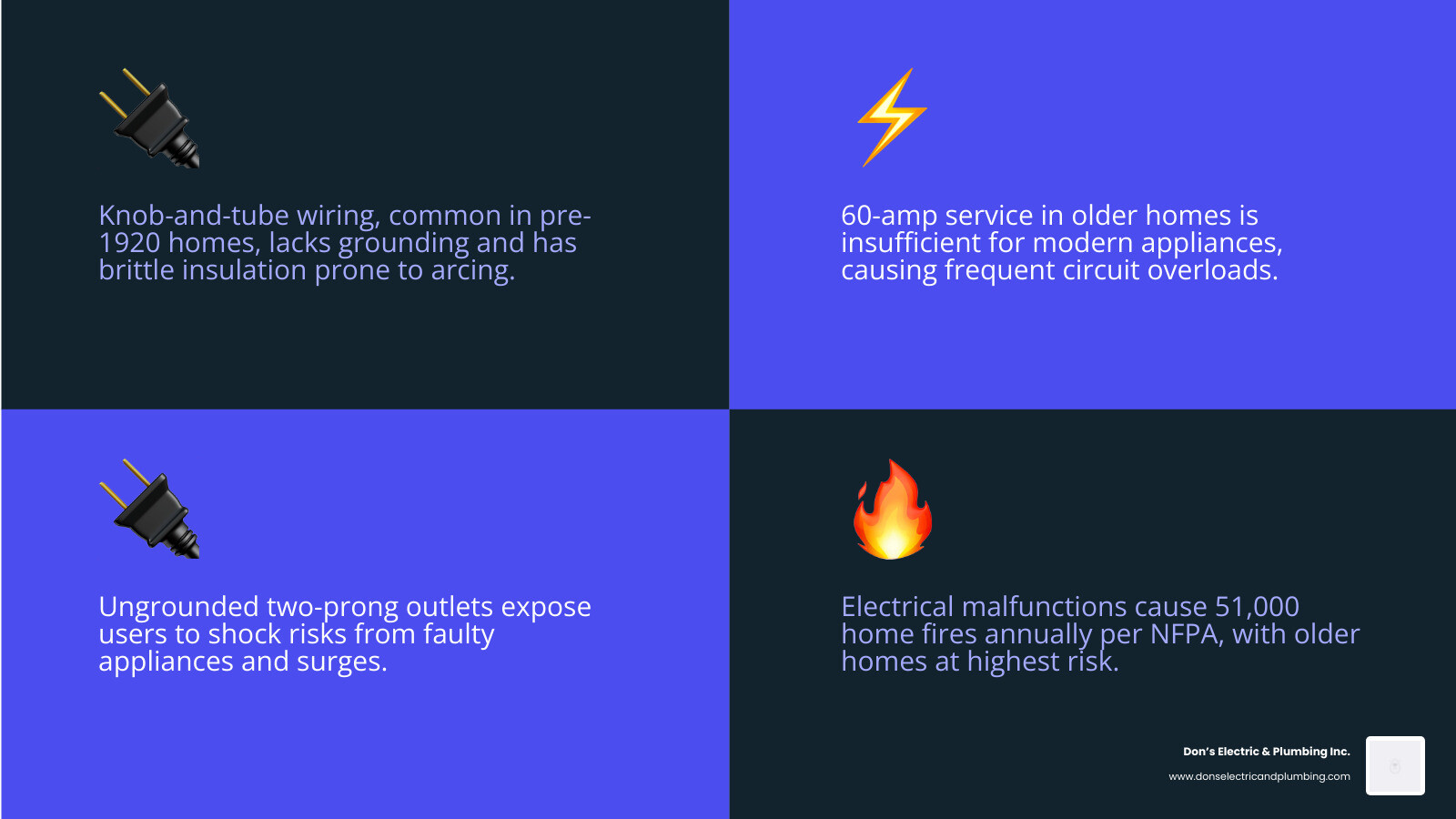
Identifying Common Hazards in Vintage Wiring
When we walk into a historic home in Montgomery or Fulton County, we often see a battle between the 19th and 21st centuries. Your home might have been built when the most high-tech appliance was a toaster, but today it’s powering high-definition TVs, air conditioners, and electric vehicle chargers. This “power gap” creates significant stress on vintage wiring.
Common hazards include cloth-insulated wiring, which tends to rot and flake away over 50+ years, leaving bare copper exposed. Another major concern is aluminum wiring, often found in homes built during the 1960s and 70s. Aluminum expands and contracts more than copper, which can lead to loose connections and “arcing”—miniature lightning strikes inside your walls that can easily start a fire.
Furthermore, many older systems are ungrounded. In a modern home, a ground wire provides a safe path for excess electricity to travel. In an ungrounded system, that “excess” electricity might choose you or your expensive electronics as its path instead. If you are planning a renovation or just moved into a classic property, you can find More info about electrical installation services to help bring your system into the modern age.
The Dangers of Knob-and-Tube (K&T) Systems
If your home was built before 1940, there is a high probability it originally had knob-and-tube wiring. This system uses porcelain “knobs” to support wires and porcelain “tubes” to protect them as they pass through wood framing.
While K&T wasn’t inherently “bad” when installed, it has several fatal flaws today:
- No Ground Wire: K&T only has a “hot” and a “neutral” wire. There is no third wire to protect against surges or faults.
- Brittle Insulation: The rubberized cloth insulation becomes brittle and disintegrates over time, especially in hot attics.
- Air-Cooled Design: K&T was designed to dissipate heat into open air. If a previous owner added modern blown-in insulation over the wires, they can overheat and ignite.
- Insurance Issues: Many insurance companies in New York will outright deny coverage or charge massive premiums if they discover active K&T wiring.
Why Outdated Electrical Panels are a Risk
The electrical panel is the “heart” of your home’s power. In many historic homes in Schoharie or Herkimer County, we still find original fuse boxes or panels rated for only 60 amps. Modern code generally requires a minimum of 100 amps for insurance eligibility, though 200 amps is the current standard for a comfortable modern lifestyle.
Old breakers are also prone to “freezing.” A breaker’s job is to trip and cut power if the circuit is overloaded. In aged panels, the internal mechanism can fail, allowing the wires to get hotter and hotter until they melt or catch fire, rather than simply shutting off.
| Feature | 60-Amp Service (Outdated) | 200-Amp Service (Standard) |
|---|---|---|
| Capacity | Struggles with a single AC unit | Handles multiple ACs, EV chargers, and appliances |
| Safety | High risk of circuit overload | Modern AFCI/GFCI breaker compatibility |
| Insurance | Hard to insure; high premiums | Preferred by all major carriers |
| Expandability | No room for new circuits | Plenty of space for future upgrades |
The Ultimate Electrical Safety Checklist for Older Homes
Maintaining a historic home is a labor of love, but safety shouldn’t be left to chance. We recommend a thorough visual audit of your system at least twice a year—perhaps when you change your clocks for Daylight Saving Time.
Start by checking the “temperature” of your home. Walk through and touch your outlet faceplates. If any feel warm or hot to the touch, stop using them immediately. This is a sign of a loose connection or an overloaded circuit. Similarly, listen for “buzzing” or “humming” sounds coming from switches. This often indicates electrical arcing. And of course, the “nose test” is vital; if you ever smell something like burning plastic or a “fishy” odor (which is often the smell of melting wire insulation), call us immediately. For those who find issues during their walk-through, you can get More info about electrical repair services to resolve these hazards.
Room-by-Room Electrical Safety Checklist for Older Homes
Every room has different power needs and risks. Here is how to break down your audit:
Kitchen and Bathrooms (The “Wet” Areas):
- GFCI Protection: Are all outlets within six feet of a water source equipped with Ground Fault Circuit Interrupters (the ones with “Test” and “Reset” buttons)?
- Appliance Loads: Are high-wattage appliances like air fryers or microwaves plugged directly into wall outlets rather than extension cords?
- Exhaust Fans: Ensure bathroom fans are clear of dust and moisture to prevent motor overheating.
Living Areas and Bedrooms:
- Wattage Limits: Check your light fixtures. Are you using 100-watt bulbs in a fixture rated for only 60 watts? This “overlamping” is a common cause of ceiling fixture fires.
- Tamper-Resistant Receptacles: If you have children or grandchildren visiting your historic home, ensure outlets have internal shutters to prevent them from sticking objects inside.
- Electric Blankets: Inspect these for charred spots or frayed wires before winter use.
Exterior and Basement Electrical Safety Checklist for Older Homes
The basement is often where the most “creative” (and dangerous) DIY electrical work hides.
- Foundation Moisture: If your basement in Hamilton County is prone to dampness, ensure all electrical boxes are mounted high and dry.
- Sump Pump Circuits: Your sump pump should ideally be on its own dedicated circuit to ensure it doesn’t trip a breaker shared with a vacuum cleaner right when a storm hits.
- Weatherproof Covers: Check your outdoor outlets. They should have “in-use” covers that protect the plug even when a cord is inserted.
- Grounding Rods: Ensure the copper rod driven into the ground outside your home is securely connected to your panel.
If you find your outdoor spaces are lacking proper power or safety, check out More info about lighting services for secure outdoor solutions.
Modernizing Your Historic Electrical System
Modernizing doesn’t mean you have to tear down your beautiful lath-and-plaster walls. Many upgrades can be done with minimal disruption. The goal of modernizing is to move from a system that simply “works” to one that proactively protects you.
One of the biggest leaps in safety is the installation of Arc-Fault Circuit Interrupters (AFCIs). While GFCIs protect you from shocks near water, AFCIs protect your whole house from fires by detecting dangerous electrical arcs and shutting off the power in milliseconds. We also highly recommend whole-home surge protection. With the amount of sensitive electronics we use today, a single lightning strike near your home in Canajoharie could fry every appliance you own. A surge protector at the main panel acts as a shield for the entire house. If you’re upgrading your home’s comfort alongside its safety, see More info about AC installation services.
The Role of GFCI and AFCI Devices
Think of these devices as your home’s “nervous system.” They are designed to react faster than a human ever could.
- GFCI (Ground Fault): These monitor the flow of electricity. If the “outgoing” and “incoming” current don’t match (meaning electricity is leaking out—possibly through you), it cuts the power. They are required by the National Electrical Code in all wet areas.
- AFCI (Arc Fault): These are “smart” breakers that can tell the difference between a harmless arc (like the spark when you plug in a vacuum) and a dangerous one (like a nail driven through a wire). They are now required for most living areas in new constructions and major renovations.
Addressing Two-Prong Outlets and Grounding
If your home is full of two-prong outlets, you’ve likely used those little gray “cheater” adapters. Here’s the truth: those adapters only work if the center screw of the outlet is actually connected to a grounded metal box. In most old homes, it isn’t.
Simply swapping a two-prong outlet for a three-prong one without adding a ground wire is a “bootleg ground” and is a major code violation. It tricks appliance testers into thinking the outlet is safe when it isn’t. The safest way to address this is to have an electrician run a new three-wire circuit or, in some cases, install a GFCI outlet labeled “No Equipment Ground.” This provides shock protection even without a ground wire.
When to Call a Professional Electrician
We love a good DIY project, but electricity is the one area where “guessing” can be fatal. You should reach out to a professional if you experience:
- Flickering Lights: This often indicates a loose “neutral” wire in your panel or at the weather head outside.
- Tingling Sensations: If you feel a slight “zap” when touching a metal appliance or faucet, your home has a serious grounding issue.
- Circuit Breaker “Whack-a-Mole”: If you can’t run the toaster and the coffee maker at the same time without a trip to the basement, your system is overloaded.
- Panel Age: If your panel has a brand name like Federal Pacific, Zinsco, or Sylvania, these are known fire hazards and should be replaced immediately.
Sometimes, electrical issues are actually tied to other home systems. For instance, a leaking pipe dripping onto a junction box is a recipe for disaster. If you suspect plumbing issues are complicating your home safety, find More info about plumbing repair services.
Frequently Asked Questions about Older Home Safety
How often should electrical safety inspections be performed in older homes?
For homes over 40 years old, we recommend a professional inspection every 1 to 2 years. The U.S. Consumer Product Safety Commission (CPSC) suggests a general safety check every six months. Regular maintenance is the key to longevity. Just like your heating and cooling systems need seasonal care, your wires need an expert eye to ensure they aren’t degrading. To keep all your home systems in top shape, consider More info about HVAC maintenance plans.
Why are two-prong outlets considered a safety risk?
Two-prong outlets lack a ground wire. Modern appliances use that third prong to divert excess electricity safely to the earth in the event of a malfunction. Without it, that surge can destroy your appliance’s circuit board or cause a significant electric shock to anyone touching the device.
What are the warning signs of an overloaded old system?
The most common signs are lights that dim when the refrigerator kicks on, outlets that are discolored (brown or black scorch marks), and breakers that trip frequently. You might also hear a faint “sizzling” or “popping” sound inside your walls. These aren’t just annoyances—they are your home’s way of screaming for help.
Conclusion
Preserving a historic home in Montgomery, Fulton, or Schoharie County is a rewarding journey, but it requires vigilance. By following an electrical safety checklist for older homes, you can enjoy the vintage charm of your property without the modern fear of an electrical fire.
At Don’s Electric & Plumbing Inc., we’ve been a family-owned and operated staple of the Canajoharie, NY community since 1984. We understand the unique architectural challenges of our region, from the Victorian beauties in Sharon Springs to the sturdy farmhouses in Palatine. We stand behind our work with a 100% guarantee and offer emergency services because we know electrical issues don’t follow a 9-to-5 schedule.
Don’t wait for a spark to tell you there’s a problem. Schedule an electrical safety assessment today and let us help you keep your family safe and your historic home’s lights shining bright for another century.