


What Size Air Conditioner Do I Need? A Quick Answer for Homeowners
What size air conditioner do I need is one of the most common questions homeowners ask before buying or replacing a cooling system — and getting it wrong can cost you real money. An AC that’s too small will run constantly without keeping up. One that’s too large will short-cycle, leaving your home feeling humid and clammy while wearing out the equipment faster. The sweet spot — that Goldilocks zone — depends on your home’s square footage, insulation, climate, and several other factors.
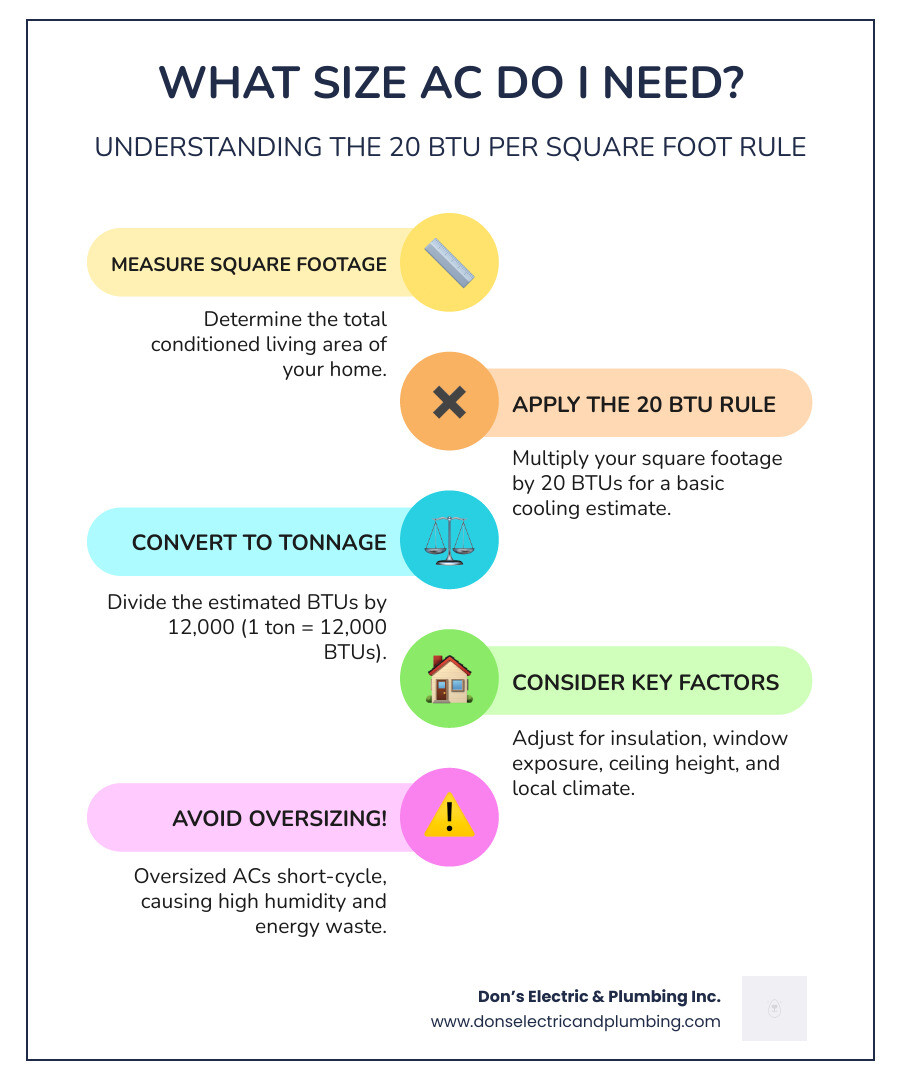
Here’s a fast starting point based on the widely used 20 BTU per square foot rule:
| Home Size (Sq Ft) | Estimated BTUs Needed | Approximate Tonnage |
|---|---|---|
| 600 – 1,000 | 18,000 BTUs | 1.5 tons |
| 1,000 – 1,500 | 24,000 BTUs | 2 tons |
| 1,500 – 2,000 | 30,000 BTUs | 2.5 tons |
| 2,000 – 2,500 | 34,000 – 40,000 BTUs | 3 – 3.5 tons |
| 2,500 – 3,300 | 42,000 – 48,000 BTUs | 3.5 – 4 tons |
Note: These are starting estimates only. Your actual needs depend on insulation quality, ceiling height, sun exposure, local climate, and more. Homes in the Montgomery County and Schoharie County area have their own regional demands that can shift these numbers.
This guide walks you through everything — from the basic BTU formula to decoding your existing unit’s model number to understanding why a professional load calculation is the gold standard for getting it right.
Understanding Cooling Capacity: BTUs and Tonnage
When we talk about the “size” of an air conditioner, we aren’t talking about how much it weighs or how many inches wide it is. In the HVAC world, size refers to cooling capacity. This is measured in British Thermal Units (BTUs). One BTU is roughly the amount of energy required to heat or cool one pound of water by one degree Fahrenheit. For your AC, the BTU rating tells us how much heat the unit can remove from your home in one hour.
You will also hear the term “tonnage.” This can be a bit confusing—rest assured, we aren’t putting a 4,000-pound block of metal in your yard! One “ton” of cooling capacity is equal to 12,000 BTUs per hour. This terminology actually dates back to the days before mechanical refrigeration, when people used literal tons of ice to cool buildings.
Most residential central air conditioning units range from 1.5 tons (18,000 BTUs) to 5 tons (60,000 BTUs). If you find yourself wondering exactly how these numbers apply to your specific home layout in Montgomery County, our team can provide expert AC service in Canajoharie to help translate these technical specs into everyday comfort.
Calculating Capacity: What Size Air Conditioner Do I Need?
The most basic way to estimate your needs is by looking at your home’s total square footage. As a general rule of thumb, you need about 20 BTUs for every square foot of living space. However, this is just the baseline. If you have vaulted ceilings higher than the standard 8 or 9 feet, you have more “air volume” to cool, which means you’ll need more power.
To give you a better idea of how this scales for whole-house systems, look at the table below:
| Square Footage | Required BTUs | Recommended Tonnage |
|---|---|---|
| 800 – 1,200 | 24,000 | 2.0 Tons |
| 1,200 – 1,500 | 30,000 | 2.5 Tons |
| 1,500 – 1,800 | 36,000 | 3.0 Tons |
| 1,800 – 2,200 | 42,000 | 3.5 Tons |
| 2,200 – 2,600 | 48,000 | 4.0 Tons |
| 2,600 – 3,200 | 60,000 | 5.0 Tons |
That factors like the age of your home and the quality of your windows play a huge role. For more answers on how your specific home setup impacts these numbers, check out our HVAC system FAQ.
How do I know what size air conditioner do I need for a single room?
If you are looking at a window unit or a ductless mini-split for a specific room rather than the whole house, the math changes slightly. You still start with the square footage (length x width), but you must account for the room type and occupancy.
- The Kitchen Factor: Kitchens generate a lot of heat from appliances. If you’re cooling a kitchen, add 4,000 BTUs to your estimate.
- The People Factor: If the room is regularly occupied by more than two people, add 600 BTUs for every additional person.
- Sun and Shade: If the room is very sunny, increase your capacity by 10%. If it’s heavily shaded, you can actually reduce it by 10%.
Decoding model numbers to see what size air conditioner do I need to replace
Are you curious about the size of the unit you currently have? You don’t need a magnifying glass to find a hidden label; the answer is usually right in the model number on the outdoor condenser unit.
Look for a long string of letters and numbers. Somewhere in that string, you’ll likely see a two-digit number that is a multiple of 6 or 12. These numbers represent the BTUs in thousands. For example:
- 18 = 18,000 BTUs (1.5 Tons)
- 24 = 24,000 BTUs (2 Tons)
- 30 = 30,000 BTUs (2.5 Tons)
- 36 = 36,000 BTUs (3 Tons)
- 42 = 42,000 BTUs (3.5 Tons)
- 48 = 48,000 BTUs (4 Tons)
- 60 = 60,000 BTUs (5 Tons)
If your current unit is struggling, it might not be a sizing issue at all—it could just need a tune-up. We offer professional AC repair to help you determine if your system is the right size but simply needs some TLC.
Why “Bigger is Not Better” and the Risks of Incorrect Sizing
In many areas of life, bigger is better. In HVAC, “bigger” can be a disaster. If an AC unit is too large for the space, it will engage in something called short-cycling. This means the unit turns on, blasts the house with cold air, reaches the target temperature in five minutes, and shuts off.
While that sounds efficient, it’s actually the opposite. Air conditioners have two jobs: lowering the temperature and removing humidity. Humidity removal happens during the later part of a cooling cycle. If the cycle is too short, the air gets cold, but the moisture stays. This results in a “damp and clammy” feeling and can eventually lead to mold growth. Furthermore, the constant starting and stopping puts immense strain on the compressor, shortening the system’s lifespan and spiking your energy bills.
On the flip side, an undersized unit will run 24/7, struggling to keep up with the summer heat in Fulton County. This leads to premature wear and tear and a house that never quite feels comfortable. If your system is acting up, our HVAC troubleshooting guide can help you identify if sizing is the culprit.
Advanced Sizing Factors and Efficiency Ratings
Beyond square footage, we have to look at how your home “holds” air. This is where things get a bit more technical.
- Insulation R-Value: How well is your attic insulated? Better insulation means you can often get away with a slightly smaller unit because the cool air stays inside.
- Windows: Are they single-pane or double-pane? Which way do they face? A home with giant south-facing windows will absorb significantly more heat than one with shaded, north-facing windows.
- Ductwork Quality: If your ducts are leaky or poorly designed, you could be losing up to 25% of your cooling power before it even reaches your rooms.
- SEER2 Ratings: By April 2026, efficiency standards have become even more important. SEER2 (Seasonal Energy Efficiency Ratio 2) measures how much cooling a system provides per watt of electricity used. For new systems in 2025 and 2026, we recommend looking for a SEER2 rating of 16 or higher. You can see how these ratings impact your wallet with our SEER energy savings calculator.
The Importance of a Professional Manual J Load Calculation
While the “20 BTU per square foot” rule is a great starting point, it’s not how professionals make the final call. The industry standard is called a Manual J Load Calculation.
This is a precise mathematical formula that factors in everything we’ve discussed: your home’s orientation to the sun, the exact R-value of your insulation, the number of occupants, the local climate in Schoharie County, and even the color of your roof (darker roofs absorb more heat!).
A Manual J calculation ensures that you are investing in a system that is perfectly tailored to your home’s unique needs. It’s the only way to guarantee you won’t end up with the humidity or short-cycling issues caused by improper sizing. When you choose our AC installation services, we take the time to get these measurements right the first time.
Frequently Asked Questions about AC Sizing
What is a Manual J calculation?
It is a detailed protocol used to determine the exact amount of heating and cooling a home needs. It considers the building’s materials, local weather data, and internal heat gains (like people and appliances). It is the most accurate way to answer what size air conditioner do I need.
Does a higher SEER2 rating mean faster cooling?
No. A higher SEER2 rating means the unit is more efficient—like a car that gets better gas mileage. It will cool your home just as well as a lower-rated unit, but it will use significantly less electricity to do so.
Can a smart thermostat fix an oversized AC?
Unfortunately, no. A smart thermostat is a great tool for scheduling and remote control, but it cannot change the mechanical reality of an oversized compressor. If the unit is too big, it will still short-cycle and fail to dehumidify, regardless of how “smart” the thermostat is.
Conclusion
Finding the “Goldilocks” size for your air conditioner is the difference between a summer of cool, crisp comfort and a summer of high bills and clammy air. At Don’s Electric & Plumbing Inc., we’ve been helping our neighbors in Canajoharie, Montgomery County, and Fulton County stay comfortable since 1984.
As a family-owned and operated business, we stand behind our work with a 100% satisfaction guarantee. Whether you are in Broadalbin, Sharon Springs, or right here in Canajoharie, we are ready to help you find the perfect system for your home. Don’t leave your comfort to guesswork—schedule your AC installation today and let us find the perfect fit for you.