


Why Knowing When Should You Call an Electrician Could Save Your Home
When should you call an electrician is one of the most important questions a homeowner can ask — and the answer could be the difference between a quick fix and a house fire.
Here’s a quick-reference answer:
Call an electrician right away if you notice any of the following:
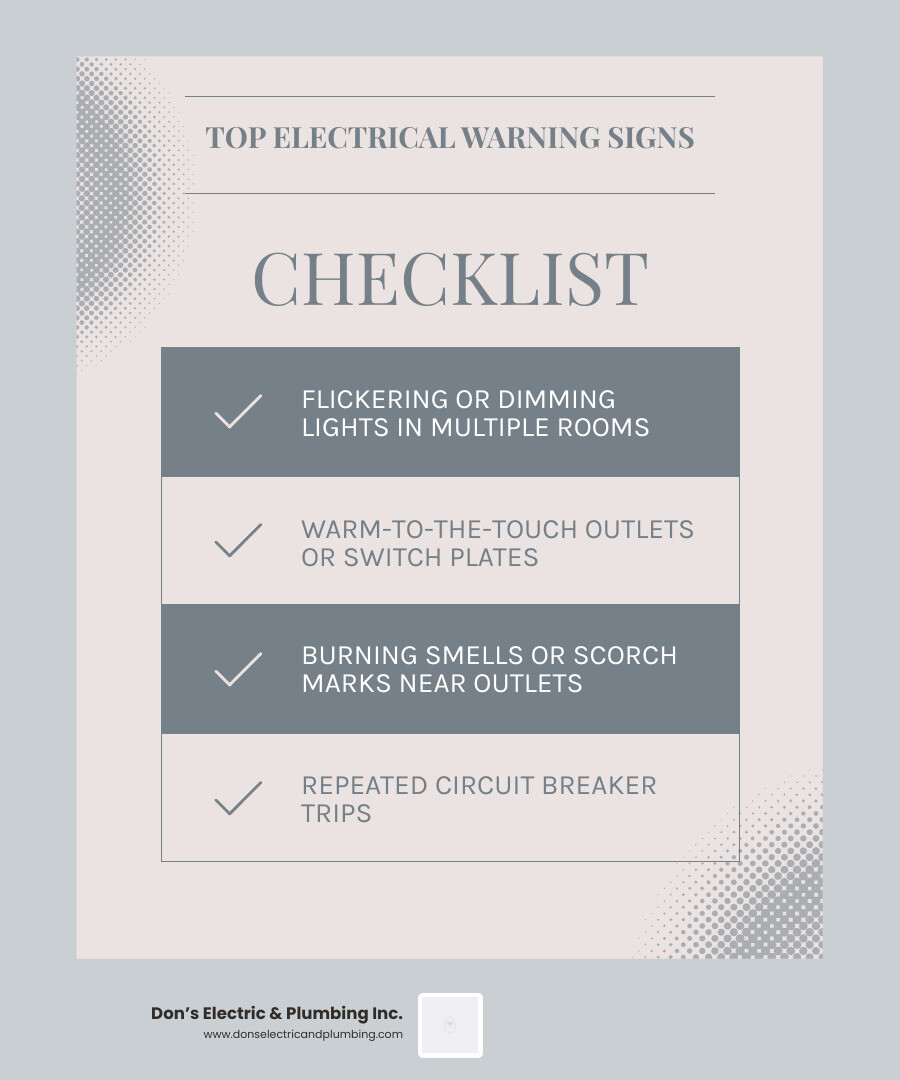
- Flickering or dimming lights, especially in multiple rooms
- Outlets or switch plates that feel warm to the touch
- A burning smell or scorch marks near any outlet or panel
- Sparks or visible arcing from outlets or switches
- Circuit breakers that trip repeatedly
- Electrical shocks or tingling when touching appliances
- Buzzing or crackling sounds from walls, outlets, or your panel
- Two-prong outlets, aluminum wiring, or cloth-insulated wires in an older home
- Exposed or damaged wiring anywhere in the home
- Heavy reliance on extension cords as a permanent solution
Electrical problems are among the leading causes of residential fires in the U.S. In fact, more than 50,000 house fires are caused by electrical malfunctions every year, resulting in an estimated $1.3 billion in property damage. Many of those fires started with warning signs that were easy to dismiss — a light that flickered here, a breaker that tripped there.
The tricky part is knowing what’s a harmless quirk and what’s an early warning that something is overheating or failing behind your walls. Most electrical problems don’t start as emergencies. They start small. And they rarely fix themselves.
This guide will help you figure out exactly when to pick up the phone — and why waiting can cost you far more than a service call.
When Should You Call an Electrician? Top Warning Signs
Electricity is the silent backbone of our homes in Canajoharie and throughout Montgomery and Fulton Counties. Because it works quietly in the background, it is easy to take for granted until a “niggle” turns into a nightmare. Recognizing the early symptoms of a failing system is the best way to prevent property damage.
One of the most overlooked signs is a warm-to-the-touch light switch plate or outlet. If you place your hand on a wall plate and it feels warmer than the surrounding wall, this is a major red flag. It often indicates that the circuit is drawing too much current or that there is a loose connection causing resistance. Resistance generates heat, and heat eventually leads to fire.
Another auditory warning is buzzing or crackling sounds. A healthy electrical system should be silent. If you hear a faint hum, sizzle, or “bee-like” buzzing from your walls or outlets, it usually means electricity is jumping across a gap—a phenomenon known as arcing. This generates intense heat that can ignite drywall or insulation in seconds.
If you find yourself constantly resetting the same switch in your panel, you are experiencing frequent breaker trips. A circuit breaker is a safety device designed to shut off power when a circuit becomes overloaded. While an occasional trip might happen if you run a space heater and a vacuum at the same time, repeated trips signal a deeper issue, such as a short circuit or a panel that can no longer handle your home’s power demands.
For comprehensive support, our team provides expert electrical services to diagnose these hidden faults. We also offer specialized lighting services for those experiencing fixture-specific issues.
Why Persistent Flickering Means You Should Call an Electrician
We have all seen a light bulb flicker occasionally, but when it becomes a regular occurrence, it is rarely just a “bad bulb.” Persistent flickering or dimming—especially when a large appliance like your refrigerator or AC kicks on—usually points to one of four serious problems:
- Loose Wiring: This is the most common cause. Over time, wires can expand and contract, loosening the connections. A loose wire is a fire hazard.
- Voltage Fluctuations: If your lights brighten and dim unexpectedly, your home may be receiving inconsistent voltage, which can fry sensitive electronics like computers and TVs.
- Appliance Surges: If your ceiling lights dim every time the microwave starts, your circuits are likely overloaded and need to be separated.
- Grounding Issues: Inconsistent lighting can sometimes indicate that your home’s grounding system is failing, leaving you vulnerable to power surges and shocks.
When Should You Call an Electrician for Outdated Wiring?
The age of your home in areas like Sharon Springs or Little Falls plays a massive role in your electrical safety. If your home hasn’t had a professional inspection in over 25 years, it is likely overdue for an electrical installation upgrade.
Keep an eye out for these antiquated systems:
- Aluminum Wiring: Common in homes built between 1965 and 1975, aluminum is softer than copper and expands more when hot. This leads to loose connections and is a significant fire risk.
- Two-Prong Outlets: These outlets lack a ground wire, meaning there is no safe path for “stray” electricity to go. This increases the risk of both fire and electrocution.
- Cloth Insulation: In very old homes, wires were often wrapped in cloth or rubber that becomes brittle and flakes off over time, leaving bare, “hot” wires exposed inside your walls.
- Knob-and-Tube Systems: This is the oldest form of wiring. It was never intended to handle the load of modern appliances like high-definition TVs and electric vehicle chargers.
Electrical Emergencies and Immediate Hazards
Some situations move beyond “warning signs” and straight into “emergency” territory. If you experience any of the following, you should turn off your main breaker (if safe to do so) and call for help immediately.
Burning Smells and Acrid Smoke: If you detect a faint odor of melting plastic or ozone, do not ignore it. This is often the first sign of an electrical fire starting inside a junction box or behind the drywall. If you see scorch marks—brown or black streaks around an outlet—the arcing has already reached a dangerous temperature.
Electrical Shocks and Tingling: Have you ever felt a small “zap” or a tingle when touching a toaster, a metal faucet, or a light switch? This is never normal. It indicates a grounding fault where electricity is using you as a path to the ground. This can escalate into a lethal electrocution without warning.
Exposed Wires and Arcing: Visible sparks or “popping” sounds from an outlet are signs of arcing electricity. Arcing generates heat that can instantly ignite nearby materials. If you have exposed or frayed wires, they pose an immediate touch hazard to children and pets.
If your electrical issues are affecting your climate control, you might also need to look into HVAC troubleshooting to ensure your heating or cooling system hasn’t been damaged by power surges.
Electrician vs. Power Company: Who Do You Call?
It can be confusing to determine who is responsible for a power issue. Generally, the power company (the utility) handles everything up to the “service point” (where the lines hit your house), while the homeowner is responsible for everything from the meter box inward.
| Situation | Who to Call |
|---|---|
| Downed power lines in the street | Power Company (Stay away!) |
| Entire neighborhood is dark | Power Company |
| Power is out in only half of your house | Electrician |
| Meter box is pulled away from the house | Electrician (then Power Company to reconnect) |
| Main breaker trips and won’t reset | Electrician |
| Transformer on the pole is sparking | Power Company |
| Water leaking into your electrical panel | Electrician & Plumbing Repair |
If you lose power, check with your neighbors first. If their lights are on but yours are off, the problem is likely internal to your home, and you need a professional electrician.
The Hidden Dangers of DIY Electrical Repairs
In the age of online tutorials, it is tempting to try and swap out a breaker or rewire a “mystery switch” yourself. However, electrical work is one of the few home repairs where a mistake can be fatal.
- Fire Hazards: Improperly tightened connections or using the wrong wire gauge can lead to heat buildup and fires that may not start until weeks after the “repair” is finished.
- Electrocution: Even if you turn off the breaker, some components (like the main lugs in a panel) remain “live” and carry lethal voltage.
- Code Violations: Professional electricians follow the National Electrical Code (NEC). DIY work often fails to meet these standards, which can become a major headache if you ever try to sell your home.
- Insurance Denials: If a fire is traced back to unlicensed, DIY electrical work, your insurance company may have grounds to deny your claim.
- Hidden Malfunctions: A DIYer might “fix” a symptom (like a tripping breaker) by installing a higher-amp fuse, which actually creates a massive fire hazard by allowing wires to overheat.
Whether you need a furnace service that involves electrical components or a full home rewiring, hiring a licensed pro ensures your family is protected by specialized tools—like thermal imaging cameras—that can “see” heat through walls before a fire starts.
Frequently Asked Questions
What qualifies as an electrical emergency?
An emergency is any situation that poses an immediate risk of fire or injury. This includes smelling burning plastic, seeing sparks or smoke, experiencing a partial power outage (which often indicates a “dropped leg” of power that can damage appliances), or having a panel that is hot to the touch.
Why does my circuit breaker keep tripping?
Breakers trip for three main reasons: an overloaded circuit (too many things plugged in), a short circuit (a “hot” wire touching a neutral wire), or a ground fault (a “hot” wire touching a ground wire). If it happens repeatedly, it is a sign that the wiring or the breaker itself is failing.
Are GFCI outlets required in every room?
No, but they are required by code in any area where moisture is present. This includes kitchens, bathrooms, garages, laundry rooms, and outdoor spaces. GFCI (Ground Fault Circuit Interrupter) outlets are designed to shut off power in milliseconds if they detect a leak of current, preventing electrocution.
Conclusion
Your home’s electrical system is a complex network that deserves respect and professional care. While it is tempting to handle small issues yourself, the risks of fire and injury are simply too high. Knowing when should you call an electrician is about being proactive rather than reactive.
At Don’s Electric & Plumbing Inc., we have been serving our neighbors in Canajoharie, Sharon Springs, Little Falls, and the surrounding areas since 1984. As a family-owned and operated business, we treat your home’s safety as if it were our own. We offer a 100% guarantee on our work, provide emergency services for those urgent hazards, and offer financing options to ensure you never have to put safety on the back burner.
Don’t leave your family’s safety to chance. If you’ve noticed flickering lights, warm outlets, or a panel that just can’t keep up with modern life, we are here to help.
Schedule your professional electrical inspection today and gain the peace of mind that comes with a safe, code-compliant home.