


Why the Advantages of a Second Generation Family Business Matter More Than You Think
The advantages of a second generation family business are real, measurable, and often underestimated. While nearly 70% of family businesses never make it past the founder, the ones that do pass the torch successfully tend to come out stronger — with deeper roots, sharper skills, and a clearer vision for the future.
Here’s a quick look at the core advantages:
- Established brand reputation — customers already know and trust the name
- Inherited operational knowledge — years of hard-won experience passed down directly
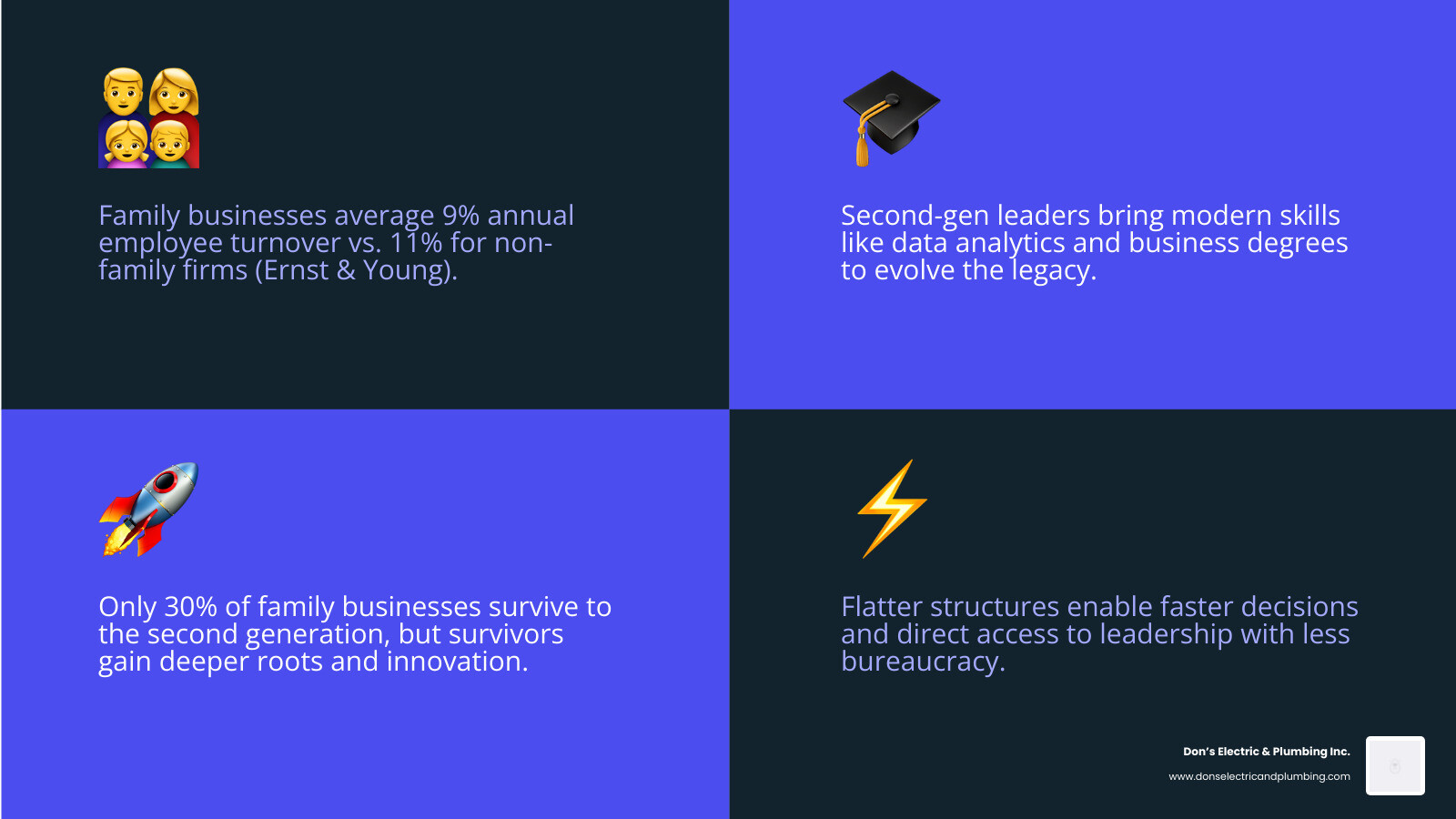
- Fresh education and modern skills — second-gen leaders often bring degrees in business, technology, or their trade
- Long-term thinking — no pressure from quarterly earnings, just a focus on lasting value
- Lower employee turnover — family businesses average just 9% annual turnover vs. 11% for non-family corporations (Ernst & Young)
- Innovation opportunity — new leadership can introduce AI, data analytics, and modernized systems
- Strong “familiness” — trust, loyalty, and values-driven culture that competitors can’t easily copy
- Flatter structure — faster decisions, direct access to leadership, less bureaucracy
At Don’s Electric & Plumbing Inc., this isn’t just theory. It’s the story of how a family-built business earns its place in a community for generations — by combining the grit of the founder with the drive and know-how of the next generation.
The Core Advantages of a Second Generation Family Business
When a business moves into its second generation, it undergoes a powerful transformation. It isn’t just a change in the name on the office door; it’s an evolution of the company’s DNA. One of the most significant advantages of a second generation family business is the ability to balance “the way we’ve always done it” with “the way we can do it better.”
Founders are often the “architects” who build the foundation through sheer grit and determination. The second generation acts as the “engineers,” taking that foundation and optimizing it for long-term stability and growth.
| Feature | Founder-Led Business | Second-Generation Business |
|---|---|---|
| Primary Focus | Survival and establishment | Growth and professionalization |
| Decision Making | Intuition and “gut feel” | Data-driven and strategic |
| Structure | Informal / Centralized | Formalized / Collaborative |
| Technology | Basic / Traditional | Advanced / Integrated |
| Risk Profile | High (Entrepreneurial) | Managed (Strategic) |
Leveraging Inherited Resources for Growth
The second generation doesn’t start from zero. They inherit a “trust bank” that has been filled over decades. In communities like Canajoharie or Sharon Springs, a family name carries weight. When we walk into a home, the customer often remembers our parents or even our grandparents. That established trust is a resource that money simply cannot buy.
Beyond reputation, the second generation inherits operational stability. The “kinks” in the service model have been worked out over thirty or forty years. This allows the new leadership to focus on expansion rather than just keeping the lights on. For example, maintaining high standards for AC service in Canajoharie, NY becomes easier when you have decades of historical data on local climate needs and housing structures.
Enhanced Education and Fresh Perspectives in a Second Generation Family Business
While the first generation often learned through trial and error, second-generation leaders frequently enter the business with specialized degrees in areas like business management, data analytics, or engineering. This “Human Capital” is a major competitive edge.
Research shows that second-generation leaders are often better prepared to operate and grow the business than commonly believed. They bring a professionalized approach to investments and management. By combining the “street smarts” of the founder with the “book smarts” of modern education, these businesses can implement sophisticated accounting methods and strategic planning that a startup might struggle to coordinate.
Modernizing the Legacy Through Technology and Innovation
One of the most exciting advantages of a second generation family business is the infusion of modern technology. Second-gen leaders are often “digital natives” who see opportunities for automation where their predecessors saw manual labor. This isn’t about replacing the human touch; it’s about using technology to make that human touch more effective.
For instance, a second-generation leader might look at a traditional furnace service in Canajoharie, NY and see a way to streamline the entire process through mobile dispatching and digital diagnostics. This modernization ensures that the business remains relevant in an increasingly tech-heavy market.
Implementing AI and Data-Driven Decisions
Artificial Intelligence (AI) isn’t just for Silicon Valley. In the trades, second-generation leaders are using AI and data analytics to revolutionize how we serve our neighbors. From predictive maintenance that tells us when a part is likely to fail to marketing automation that keeps us connected with our customers, technology is the great multiplier.
By using an HVAC troubleshooting system, we can diagnose issues faster and more accurately than ever before. This efficiency doesn’t just save time; it provides a level of precision that builds even more trust with the homeowner.
Strategic Diversification in a Second Generation Family Business
Second-generation leaders are often the ones who push the business into new territories. While the founder might have focused solely on one trade, the next generation often sees the value in becoming a total home solution provider.
Whether it’s expanding from electrical work into comprehensive plumbing service in Canajoharie, NY or exploring new sectors like green energy, this diversification is a key survival strategy. It protects the business against market fluctuations in any single service area and allows us to provide a more seamless experience for our clients across Montgomery and Schoharie counties.
Building Resilience Through Shared Values and Culture
In a corporate world that often feels cold and transactional, the “familiness” of a second-generation business is a breath of fresh air. We don’t just answer to shareholders; we answer to our family name and our community. This leads to a “Long-Term Orientation”—we make decisions based on what the business will look like in twenty years, not just the next three months.
This shared mission creates a sense of unity that radiates outward to our employees and customers. When values are passed down from one generation to the next, they become the bedrock of the company culture.
Lower Turnover and Strong Work Ethic
Statistics tell a compelling story: family businesses typically see an annual turnover rate of just 9%, compared to 11% in non-family corporations. Why? Because employees in family firms often feel like part of an extended family rather than just a number on a payroll.
There is a vested interest in the success of every team member. We take pride in our work because our performance directly impacts our family’s reputation in towns like Little Falls and Dolgeville. This environment encourages a strong work ethic and provides unique mentorship opportunities where veteran technicians pass their “lifetime of experience” down to the rookies. To keep our team and your home systems running smoothly, many customers choose to sign up for HVAC maintenance plan options that reflect this commitment to long-term care.
The Power of “Familiness” as a Competitive Edge
“Familiness” is a term used by researchers to describe the unique bundle of resources a company has because of the family’s involvement. This includes:
- Rapid Decision-Making: Because the structure is flatter, we can pivot quickly to help a customer in an emergency without waiting for corporate approval.
- Interpersonal Connection: We build genuine relationships with our neighbors in places like Ephratah and Palatine.
- Trust-Based Culture: Our team knows they are supported, which leads to higher job satisfaction and better service for you.
This competitive edge is why many family businesses are less likely to scale back their workforce during economic downturns. We prioritize people over the bottom line, which pays dividends in loyalty and community respect.
Overcoming Challenges in the Second-Gen Transition
Of course, the transition isn’t always easy. Only about 30% of family businesses make it to the second generation. The hurdles are often emotional rather than financial. Founders may struggle to “let go,” fearing a loss of identity, while second-generation leaders may feel the weight of intense scrutiny and the pressure to live up to a legacy.
To overcome these challenges, successful businesses implement clear governance structures. This might include a family council or a formalized succession plan that outlines exactly how leadership will be transferred. Professionalizing the business—hiring external advisors or non-family executives—can also help bridge the gap between generations.
Even in moments of transition, our commitment to service never wavers. Whether we are navigating a leadership change or simply a busy summer season, providing reliable AC repair service in Canajoharie, NY remains our top priority. We’ve learned that the key to survival is constant communication and a willingness to adapt.
Frequently Asked Questions about Second-Gen Businesses
Why do only 30% of family businesses survive to the second generation?
The “30% rule” is a famous statistic in the business world. The primary reasons for this drop-off aren’t usually related to bad luck or poor market conditions. Instead, they often stem from:
- Lack of Succession Planning: Many founders don’t have a formal plan for who takes over and when.
- Emotional Readiness: It can be difficult for a founder to step back from a business they built from nothing.
- Sibling Rivalry: If multiple heirs are involved, divergent interests can lead to conflict if there isn’t a clear governance structure in place.
- Failure to Innovate: Some businesses get stuck in “the old way” and fail to adapt to new technologies or customer expectations.
How does direct access to decision-makers benefit the company?
In a second-generation family business, the organizational structure is typically much flatter than in a large corporation. This agility is a massive benefit. When a strategic idea comes up—like implementing new energy-saving technology—it goes straight to the owners. There is no corporate bureaucracy to navigate. This allows for rapid implementation and ensures that the business can stay ahead of local trends and needs. It also creates a better environment for employees, who know their voices are heard by the people who actually own the company.
What role does family governance play in long-term sustainability?
Governance is the “secret sauce” of multi-generational success. It’s about creating rules for how the family interacts with the business. This includes:
- Ownership Councils: Deciding who can own shares and how they can be sold.
- Shared Mission: Ensuring everyone is working toward the same long-term goals.
- Conflict Management: Having a pre-set process for resolving disagreements before they affect the business operations.
- Education: Teaching the next generation the values and skills they need to be good stewards of the family legacy.
Conclusion
At Don’s Electric & Plumbing Inc., we believe that being a family-owned business is our greatest strength. Since 1984, we’ve served our neighbors in Montgomery, Fulton, Schoharie, Herkimer, and Hamilton counties with a 100% guarantee. We aren’t just a service provider; we are your neighbors, and we understand the unique needs of homes in our area.
The advantages of a second generation family business allow us to offer you the best of both worlds: the reliability and trust of a long-standing local name, combined with the cutting-edge technology and professionalized service of a modern enterprise. Whether you need an emergency repair or a new installation, you can count on us to treat your home like our own.
Ready to experience the second-gen advantage for yourself? Schedule an estimate today and let our family take care of yours.