


How Long Does the Average Lifespan of an HVAC System Actually Last?
The average lifespan of an HVAC system is typically between 15 and 25 years — but that number shifts depending on the type of equipment you have, how well it’s been maintained, and where you live. For homeowners in Schoharie, Montgomery, and Fulton counties, where winters can be brutal and summers humid, getting the most out of your heating and cooling system isn’t just a comfort issue — it’s a practical one.
Here’s a quick breakdown by system type:
| HVAC System Type | Average Lifespan |
|---|---|
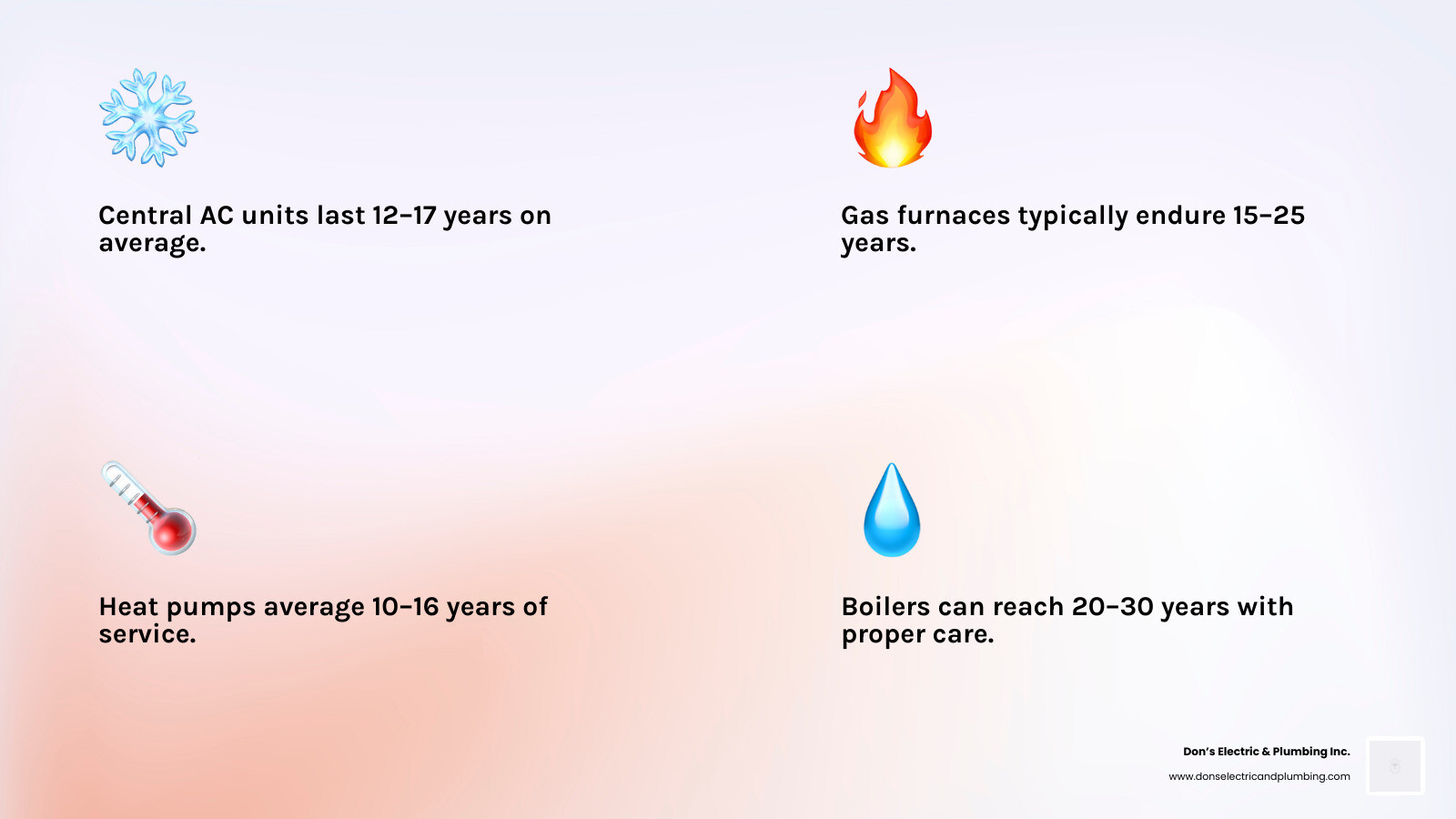
| Central Air Conditioner | 12–17 years |
| Gas Furnace | 15–25 years |
| Heat Pump | 10–16 years |
| Boiler | 20–30 years |
| Geothermal Heat Pump | 25–30 years |
| Ductless Mini-Split | 15–20 years |
These ranges come from industry sources including ASHRAE field data and DOE modeling — and they assume a reasonably well-maintained system. A neglected unit can fall well short of these numbers. A carefully maintained one can sometimes exceed them.
That said, age alone doesn’t tell the whole story. Some systems quietly become money pits long before they completely stop working — racking up repair bills and driving up energy costs month after month. Knowing when to hold on and when to let go is what this guide is all about.
Understanding the Average Lifespan of an HVAC System by Unit Type
When we talk about the average lifespan of an HVAC system, we have to look at the individual components. Your home comfort setup is rarely a single “box.” It’s a collection of mechanical parts, electrical circuits, and refrigerant lines working in tandem. In our experience serving the Canajoharie and Palatine areas since 1984, we’ve seen how different technologies age under the pressure of New York’s seasonal shifts.
Central Air Conditioners
Standard central AC units generally last between 12 and 17 years. Because the condensing unit sits outside, it is constantly exposed to the elements—rain, snow, and fluctuating temperatures. Over time, the coils can corrode, and the compressor (the “heart” of the system) can begin to fatigue. If your unit was installed before 2010, it likely uses R-22 refrigerant, which is now phased out, making even minor repairs quite complicated.
Gas Furnaces and Boilers
Heating units tend to have a longer stay in your home. A gas furnace typically lasts 15 to 25 years, while a well-maintained boiler can easily reach the 30-year mark. Because these units are housed indoors (usually in a basement or utility closet), they are protected from the harsh Upstate NY weather. However, the heat exchanger is the critical failure point here; if it cracks due to age and stress, the unit must be replaced immediately for safety reasons.
Heat Pumps and Ductless Mini-Splits
Heat pumps are the “workhorses” of the HVAC world because they provide both heating and cooling. Because they run year-round rather than taking a season off, their average lifespan of an hvac system component is slightly shorter, usually 10 to 16 years. Ductless mini-splits, which use inverter technology to vary their speed, often fare a bit better, reaching up to 20 years with proper care. For those considering an upgrade in the Minden area, understanding these lifecycles is key to long-term planning. You can learn more about modern options through our HVAC installation Minden services.
Geothermal Systems
Geothermal is the marathon runner of the industry. The indoor heat pump unit lasts about 25 to 30 years, but the underground loop system—the pipes buried in your yard—can last 50 years or more. It is a significant investment in longevity.
Why the average lifespan of an hvac system varies
No two homes are identical, and neither is the wear and tear on their systems. Several factors cause these numbers to fluctuate. Usage patterns play a massive role; a system that “short-cycles” (turns on and off too frequently) will burn out its motor much faster than one that runs in steady, efficient cycles.
We also find that airflow balancing Palatine is a frequently overlooked factor. If your system is fighting against restricted ducts or poor pressure, it works twice as hard to move the same amount of air, shaving years off its life.
Realistic expectations for modern equipment
It is a bit of a paradox: modern equipment is more efficient than ever, but it is also more complex. Older “clunker” units from the 1970s were built with thick, heavy metals that lasted forever but used a mountain of energy. Today’s systems use thinner, high-efficiency coils and sensitive electronic boards.
According to ASHRAE (the American Society of Heating, Refrigerating and Air-Conditioning Engineers), which maintains a database of nearly 40,000 data points, the median service life for a gas furnace is about 18 years. As of April 2026, manufacturing standards continue to prioritize energy SEER2 ratings. This means while your new unit might not last 40 years like your grandfather’s furnace, it will likely pay for itself in energy savings within the first decade.
Key Factors That Influence Equipment Longevity

If you want your system to reach the upper end of that 15-to-25-year window, you have to look at the environment and the “envelope” of your home.
Installation Quality: The Foundation of Life
The most critical day in the life of your HVAC system is the day it is installed. A unit that is improperly sized—either too big or too small—is doomed from the start. A unit that is too large will cool the house so fast that it shuts off before it can dehumidify the air, leading to “short-cycling” and premature compressor failure. We take pride in our precision as an air duct contractor Gloversville, ensuring that every installation is calibrated for the specific square footage and duct capacity of the home.
Climate and Environmental Impact
Here in Montgomery and Fulton counties, we deal with high humidity in the summer and sub-zero temperatures in the winter. This “thermal cycling” puts immense stress on metals. In coastal areas, salt air is the enemy; here, it’s often dust, pollen, and the occasional ice storm. If an outdoor unit is buried in a snowbank or choked by overgrown weeds, it can’t “breathe,” which causes the internal temperature of the unit to spike and damages the components.
Maximizing the average lifespan of an hvac system through maintenance
Maintenance isn’t just a “good idea”—it’s often a requirement to keep your manufacturer’s warranty valid. The single biggest reason for premature HVAC death is neglect.
- Filter Changes: A clogged filter is like trying to breathe through a straw while running a marathon. It forces the blower motor to work harder, leading to burnout.
- Coil Cleaning: Dirty coils can’t exchange heat efficiently.
- Lubrication: Moving parts need to stay slick to avoid friction and heat.
Many homeowners find that a structured hvac maintenance plan Cobleskill ny is the easiest way to ensure these tasks don’t fall through the cracks.
The role of ductwork and airflow
You can have the most expensive furnace in the world, but if your “delivery system” (the ducts) is failing, the furnace will suffer. Duct leakage in many existing homes can exceed 20% to 30% of total airflow. This means your system has to run 30% longer just to get your living room to the right temperature. For homes with older or complicated layouts, custom ductwork Cobleskill can solve these pressure issues and extend the life of the central unit by reducing its total runtime.
Warning Signs It’s Time to Say Goodbye to Your Unit
Sometimes, a system doesn’t just “die”—it gives you a long, expensive series of hints that it’s ready to retire. Recognizing these signs early can save you from a “no-heat” emergency in the middle of a January night.
1. Strange Noises and Odors
Your HVAC system should be a relatively quiet background hum. If you start hearing banging, screeching, or grinding, those are mechanical distress signals. A screeching sound often points to a failing belt or motor bearing, while banging could mean a loose part is rattling around. Odors are equally concerning; a “dirty sock” smell suggests biological growth on the coils, while a burning electrical smell is a sign of overheating wires and requires an immediate shutdown.
2. Frequent and Escalating Repairs
If we’ve been to your house three times in the last two years for the same unit, it’s a sign. Like an old car, once one major component goes, the others often follow. If you’re constantly replacing capacitors, fan motors, or contactors, you’re likely just delaying the inevitable.
3. Rising Utility Bills
Keep an eye on your energy statements. If your usage is creeping up but your habits haven’t changed, your system is losing efficiency. As parts wear down, they require more electricity to perform the same amount of work. Upgrading to a modern unit can sometimes reduce energy use by over 35%.
4. The R-22 Refrigerant Factor
If your air conditioner was built before 2010, there is a high chance it uses R-22 (Freon). The EPA officially banned the production and import of R-22 in 2020. While we can still service these units, the cost of “reclaimed” refrigerant has skyrocketed. If an R-22 unit develops a leak, the cost of the repair often approaches the cost of a new, eco-friendly R-410A or R-32 system.
Performance and air quality indicators
Is your upstairs bedroom always five degrees warmer than the rest of the house? Does your home feel unusually dusty even after cleaning? These are signs of a declining system or failing ducts. Excessive dust often indicates leaks in the return ductwork pulling in attic or crawlspace air. In these cases, duct cleaning Cobleskill or a full canajoharie air duct installation guide review can help determine if the problem is the unit or the ventilation.
The 50% Rule: When to Repair vs. Replace
Deciding whether to fix an old unit or buy a new one is a math problem. We recommend two major industry “rules of thumb” to help our neighbors in Montgomery County make the right choice.
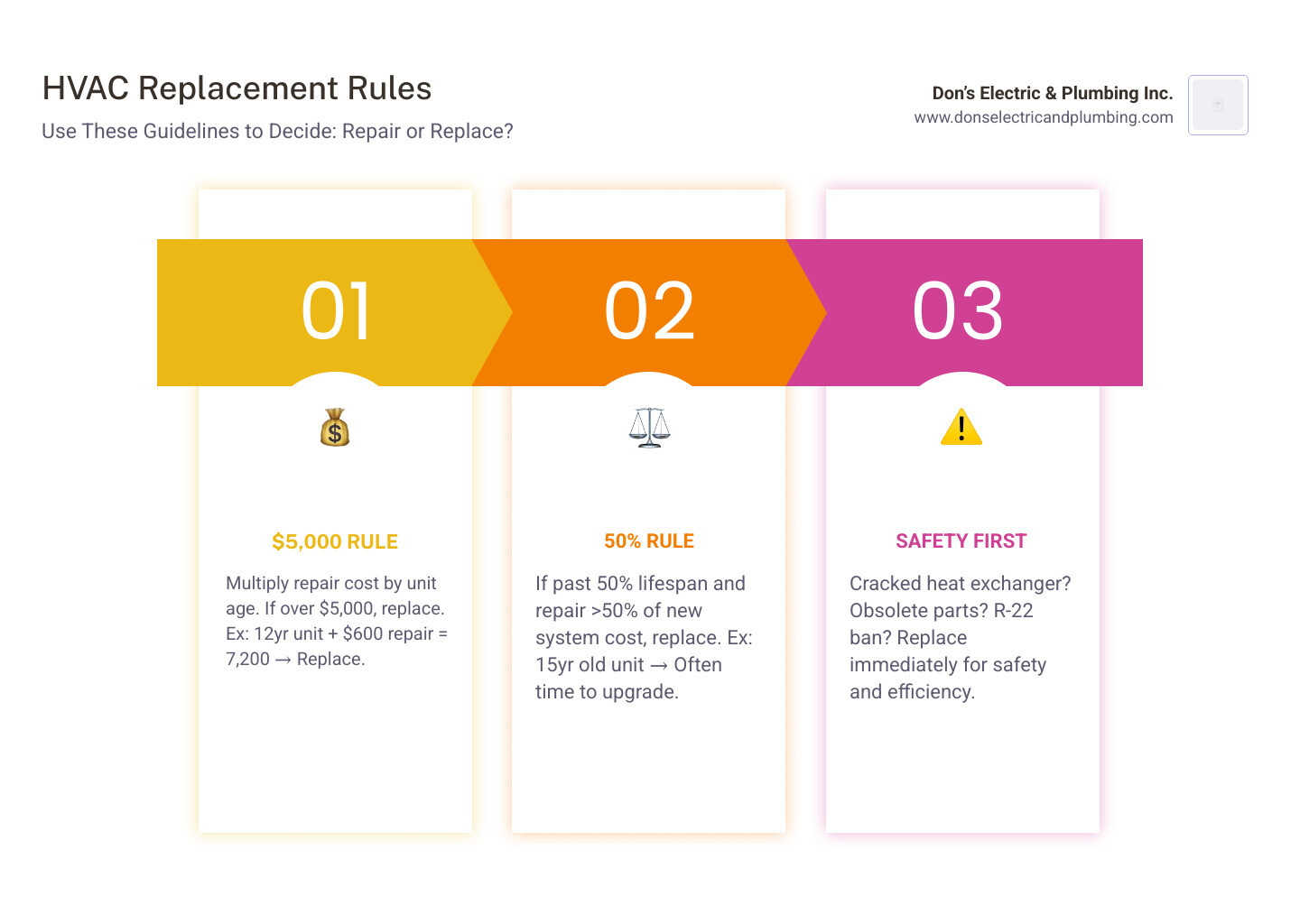
The $5,000 Rule
Multiply the age of your equipment by the cost of the repair. If the total is more than $5,000, you should strongly consider replacement.
- Example: A 12-year-old AC unit needs a $600 repair. (12 x 600 = 7,200). Since 7,200 is greater than 5,000, replacement is likely the smarter financial move.
- Example: A 5-year-old furnace needs a $300 repair. (5 x 300 = 1,500). Repair it!
The 50% Rule
If a system is past 50% of its expected lifespan and the repair cost is more than 50% of the cost of a new system, it’s time to say goodbye. This is especially true for major components like the compressor or the heat exchanger. Investing thousands into a unit that is already 15 years old is often “throwing good money after bad.”
Safety and Obsolescence
Some things aren’t negotiable. If a gas furnace has a cracked heat exchanger, it can leak carbon monoxide into your home. Per safety codes and NFPA standards, these units must be shut down. Similarly, if the mechanical parts for your specific model are no longer manufactured (obsolescence), a replacement becomes your only reliable option.
Frequently Asked Questions about HVAC Longevity
Can an HVAC system last 30 years?
While the average lifespan of an hvac system is closer to 20, some units do reach 30 years. These are usually high-quality cast-iron boilers or furnaces located in very dry, clean environments. However, even if a 30-year-old unit is still running, it is likely operating at 50-60% efficiency compared to the 90-98% efficiency of modern units. You might be “saving” money by not replacing it, but you are likely overpaying on your monthly gas or electric bill.
Should I replace my AC and furnace at the same time?
In many cases, yes. Your AC and furnace often share the same blower motor and ductwork. Replacing them together—known as a “matched system”—ensures that both halves are designed to work at the same efficiency level. It also resets the warranty clock for your entire home comfort system and can save you significantly on labor costs compared to doing them separately two years apart.
Does salt air or extreme cold affect system life?
Absolutely. While we don’t have salt air in the middle of Schoharie County, we do have road salt and extreme cold. If your outdoor unit is near a road where salt spray can reach it, corrosion can accelerate. Furthermore, extreme cold forces heating systems to run for longer durations without a break, which increases mechanical wear. Proper seasonal preparation, like clearing debris and checking for rust, is vital in our local climate.
Conclusion
At Don’s Electric & Plumbing Inc., we understand that your HVAC system is one of the most significant investments you’ll make in your home. Since 1984, our family-owned and operated team has been dedicated to helping our neighbors across Montgomery, Fulton, and Schoharie counties stay comfortable and safe.
Whether you’re trying to squeeze a few more years out of an aging unit or you’ve decided it’s finally time for a high-efficiency upgrade, we’re here to help. We offer a 100% satisfaction guarantee, financing options to fit your budget, and 24/7 emergency services for those moments when your system decides to retire at the worst possible time.
Don’t wait for a total system failure to start planning. If you’re noticing rising bills or strange noises, reach out to us for an honest assessment. For residents in the Canajoharie area, you can find more specialized information on our AC service Canajoharie ny page. Let us help you ensure your home stays a sanctuary of comfort for years to come.