


Navigating Home Services: How to Pick a Trustworthy Contractor
When you need work done on your home, knowing how to choose a reliable contractor for home services is key to a smooth project. Choosing the wrong contractor can lead to expensive delays, poor workmanship, and a lot of stress. To avoid these common pitfalls and ensure your project succeeds, follow these essential steps:
- Verify Licenses & Insurance: Always check for valid state licenses and comprehensive insurance (general liability and workers’ compensation).
- Get Multiple Estimates: Obtain at least three detailed, written estimates to compare scope, materials, and costs fairly.
- Check References & Reviews: Contact past clients and examine online reviews for consistent patterns of positive (or negative) feedback.
- Require a Detailed Contract: Ensure all project details, payment schedules, timelines, and warranties are clearly written in a contract.
- Manage Payments Wisely: Avoid large upfront deposits; typically, 10-30% is standard, with payments tied to project milestones.
Home renovation projects, whether big or small, are significant investments. Homeowners often face unexpected electrical, plumbing, or HVAC breakdowns, or plan exciting new installations. The thought of hiring someone new can be daunting, especially with common “horror stories” of renovations gone wrong. Many homeowners seek dependable, prompt, and quality service from a trusted local business. Making an informed decision helps prevent future headaches and safeguards your home and finances.
To dive deeper into ensuring your home service needs are met with excellence, explore our comprehensive services and get started by contacting us today.
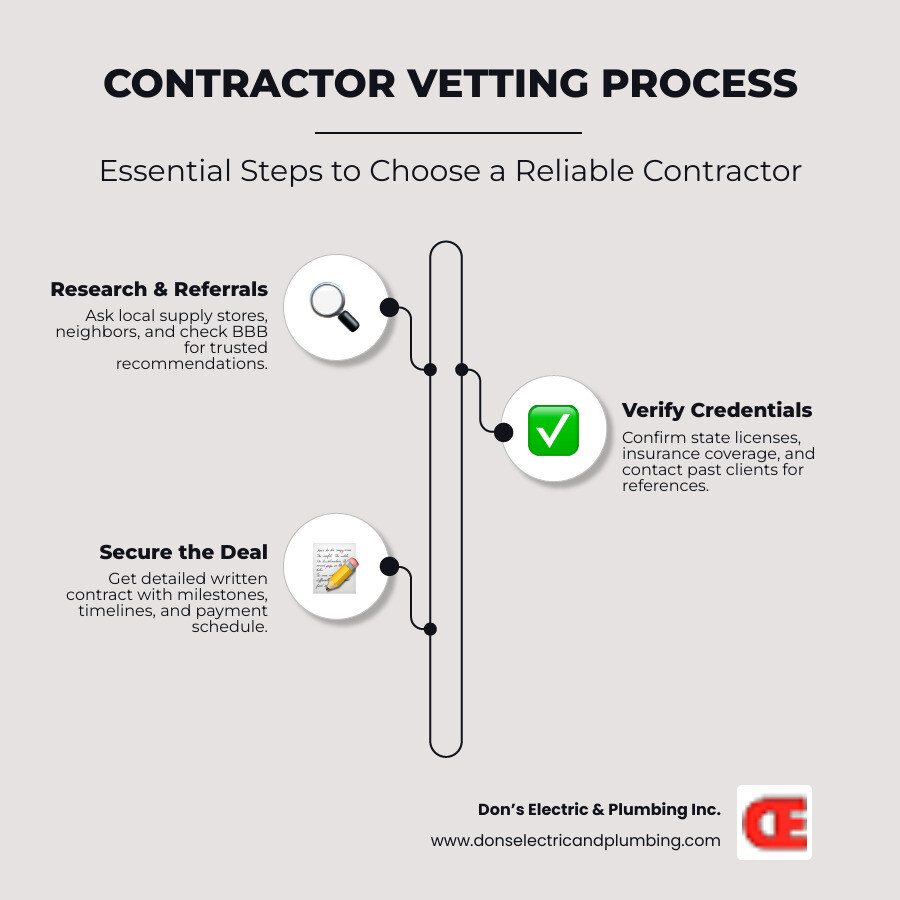
Proven Strategies for How to Choose a Reliable Contractor for Home Services
Finding a contractor shouldn’t feel like a game of chance. While the internet is the first place many people look, the most effective strategies often involve a mix of old-school networking and modern verification.
One of the most overlooked goldmines for finding talent is the local building supply store or lumber yard. Unlike big-box retailers, local supply stores in areas like Canajoharie or Little Falls interact with contractors daily. They know who pays their bills on time, who picks up quality materials, and who has been in the business for decades. If you walk into a local supplier and ask, “Who are the best plumbers or electricians in town?” you’re likely to get a list of names that have stood the test of time.
Local trade associations and the Better Business Bureau (BBB) are also vital tools. A contractor who is a member of a local builders’ association is often more invested in their professional reputation. When looking at the BBB, don’t just look at the letter grade; read the nature of any complaints and, more importantly, how the company responded to them.
When researching online, look for patterns. A single bad review in a sea of five-star ratings might just be a difficult customer, but a recurring theme of “they never showed up” or “the bill was higher than the quote” is a major red flag. For specialized needs, it is always best to look for experts who offer specific plumbing services or electrical work rather than a “jack of all trades” who might lack the deep technical knowledge required for complex home systems.
How to choose a reliable contractor for home services using references?
References are your window into the future of your project. When a contractor provides a list of past clients, don’t just let it sit in your folder—call them! A reliable contractor should be happy to provide at least three to five references from projects completed within the last year.
When you call, ask specific questions:
- Did the contractor stay within the agreed-upon timeline?
- Was the communication clear when issues arose?
- Did they leave the job site (your home!) clean at the end of every day?
- If you needed an AC repair, did the technician explain the problem in plain English?
Ideally, you want to talk to someone who had a project similar in scope to yours. If you are doing a full bathroom remodel, a reference for a leaky faucet repair won’t give you the full picture of the contractor’s project management skills.
Leveraging Local Networks and Neighbors
In close-knit communities across Montgomery and Schoharie Counties, word-of-mouth remains the king of recruitment. Your neighbors are often your best resource. If you see a service truck in a neighbor’s driveway in Sharon Springs or Palatine, don’t be afraid to ask how the work is going.
Community Facebook groups and Nextdoor can be helpful, but take them with a grain of salt. Anonymous recommendations aren’t as valuable as a neighbor you can talk to face-to-face. Drive-by observations are also useful—if you see a local home being renovated, notice if the site is orderly. A messy, chaotic job site often reflects a messy, chaotic business mind.
Verifying Credentials, Insurance, and Licensing
This is the “boring” part of the process that saves you from the biggest nightmares. In New York, licensing requirements can vary, but any legitimate contractor should be able to produce their paperwork instantly.
There are three pillars of protection you must verify:
- State/Local Licensing: This ensures the contractor has met the minimum competency standards required by law.
- General Liability Insurance: This protects your property. If a contractor accidentally starts a fire or floods your basement while performing electrical services, this insurance covers the damage. We recommend a minimum of $500,000 in coverage.
- Workers’ Compensation: This is critical. If a worker is injured on your property and the contractor doesn’t have “workers’ comp,” you—the homeowner—could be held liable for their medical bills and lost wages.
Don’t just take their word for it. Request a Certificate of Insurance (COI) and call the insurance agency listed on the document to ensure the policy is currently active.
For HVAC specifically, look for NATE (North American Technician Excellence) certification. This is the gold standard for technicians, proving they have passed rigorous testing on real-world heating and cooling equipment.
Why Business Longevity Matters
Statistics show that it typically takes three to five years for a home service business to establish financial soundness. A company that has survived the five-year milestone is much more likely to be there next year if you need to call in a warranty claim.
Longevity suggests the business is managed well and has a stable relationship with banks and suppliers. For instance, when you invest in a furnace installation, you want to know that the company will still be around in a decade to perform the necessary maintenance or handle part replacements. We have been serving our local community since 1984, and that kind of history provides a level of peace of mind that a “new kid on the block” simply can’t offer.
Essential Questions for the Interview Phase
Treat the initial meeting like a job interview—because it is! You are the boss, and they are applying to work for you. Beyond the technical scope, pay attention to their professional demeanor. Do they show up on time? Is their vehicle clean and organized? Do they wear booties to protect your floors?
Essential questions to ask include:
- Who will actually be doing the work? Many contractors use subcontractors. You need to know if those subcontractors are also licensed and insured under the main contractor’s policy.
- How do you handle permits? A reliable contractor handles the permitting process with the local building department in places like Canajoharie or Little Falls. If they ask you to get the permit, it’s often because they aren’t licensed to do so.
- What is your change-order process? Projects change. You need to know how those changes are documented and how they affect the final price.
Red Flags and Warning Signs of Unreliable Companies
Learning how to choose a reliable contractor for home services also means learning who to run away from. Trust your gut. If something feels “off” during the first meeting, it will likely get worse once the walls are opened up.
One of the biggest red flags is high-pressure sales tactics. If a contractor tells you the “special price” is only good if you sign right now, thank them for their time and show them the door. Legitimate businesses allow you the time to review estimates and make a calm decision.
Other warning signs include:
- Cash-only demands: Never pay in cash. It leaves no paper trail and is a hallmark of “fly-by-night” operations.
- No physical address: If they only have a P.O. Box or a cell phone number, how will you find them if the roof starts leaking or the furnace repair fails?
- Unprofessional behavior: This includes being late without calling, bad-mouthing other companies, or being unable to answer basic technical questions about the equipment they plan to install.
Identifying Scams and Low-Ball Estimates
We all love a good deal, but in home services, a “low-ball” estimate is often a trap. If you get three bids and one is significantly lower than the others (say, 30-50% lower), it usually means one of three things:
- Scope Misunderstanding: They didn’t actually understand the full extent of the work required.
- Corner-Cutting: They plan to use inferior materials or unskilled labor.
- Hidden Fees: They plan to hit you with “unforeseen” costs once the project is underway to make up the difference.
Always compare bids line-by-line. Does one include permit fees while the other doesn’t? Is one using high-efficiency units while the other is quoting base models?
Creating a Bulletproof Contract and Payment Schedule
A handshake is a beautiful thing, but a written contract is what protects your home. Every project, no matter how small, should have a written agreement.
A detailed contract should include:
- A complete Scope of Work (exactly what is being done).
- Materials list (specific brands and models).
- Start and completion dates.
- Payment schedule tied to milestones.
- Warranty information (both for labor and parts).
| Payment Milestone | Standard Percentage | Description |
|---|---|---|
| Deposit | 10% – 30% | Secures the date and covers initial material costs. |
| Progress Payment | 30% – 40% | Paid after a major milestone (e.g., rough-in plumbing). |
| Final Payment | 10% – 20% | Paid only after a final walkthrough and approval. |
Never pay the full amount upfront. A standard deposit is 10-30%, depending on the size of the project and the materials needed. Holding back the final 10-20% until the job is 100% complete—including the cleanup—gives you the leverage to ensure the work is finished to your satisfaction. This is especially important for long-term health items like an HVAC maintenance plan, where you want to ensure the initial setup is perfect.
Final Checklist: How to choose a reliable contractor for home services
Before you sign on the dotted line, run through this final checklist:
- [ ] Is the total price clearly stated?
- [ ] Are the payment milestones fair?
- [ ] Does the contract include a “Broom Clause” (requiring the contractor to leave the site clean)?
- [ ] Is there a termination clause that explains how either party can end the agreement if things go south?
- [ ] For specialized work like lighting services, are the specific fixtures and locations listed?
Managing the Project and Final Walkthroughs
Once the work begins, your job isn’t over. Keep a project log. Take photos of the progress, especially of things that will eventually be hidden behind walls (like wiring and pipes).
Communication is key. If you notice something that doesn’t look right, bring it up immediately. It is much easier to fix a pipe before the drywall goes up than after the tile is laid.
The project isn’t finished until the final walkthrough. This is where you create a “punch list” of small items that need to be addressed—a missed paint stroke, a loose outlet cover, or a bit of debris in the yard. Do not make that final payment until every item on the punch list is checked off and you have received all relevant warranty documents and operation manuals.
Frequently Asked Questions
How do I verify if a contractor is properly insured?
Ask the contractor for a Certificate of Insurance (COI). This document should list the insurance company, the policy numbers, and the expiration dates for general liability and workers’ compensation. To be 100% sure, call the insurance agent listed on the certificate to confirm the policy is in good standing. This protects you from being held liable for accidents that happen on your property.
What is a reasonable deposit for home service projects?
A reasonable deposit typically ranges from 10% to 30% of the total project cost. For very small jobs, some contractors may require a slightly higher percentage to cover the immediate cost of materials. For large projects, the deposit should be on the lower end, with subsequent payments tied to the completion of specific milestones. Never pay for the entire job before the work has even started.
Should I always choose the lowest bid for home repairs?
Not necessarily. While budget is important, the lowest bid can sometimes be the most expensive in the long run if the work is poor or the materials are low-quality. Compare the bids to see if the contractors are quoting the same level of service and quality of materials. A slightly higher bid from a company with a 100% satisfaction guarantee and decades of experience often provides much better long-term value and less stress.
Conclusion
Choosing the right partner for your home’s electrical, plumbing, and HVAC needs doesn’t have to be a stressful ordeal. By doing your due diligence—checking licenses, verifying insurance, and insisting on a clear, written contract—you can protect your investment and ensure your home remains a safe, comfortable sanctuary for your family.
At Don’s Electric & Plumbing Inc., we understand the trust you place in us when we enter your home. As a family-owned and operated business serving Canajoharie and the surrounding areas since 1984, we pride ourselves on our core values of honesty, reliability, and technical excellence. We stand behind our work with a 100% satisfaction guarantee and offer emergency services to ensure you’re never left in the dark or out in the cold.
Whether you need a quick repair or a major installation, our team is ready to help. Don’t leave your home’s vital systems to chance. Schedule your professional estimate today and experience the peace of mind that comes with hiring a contractor who truly cares about our community.